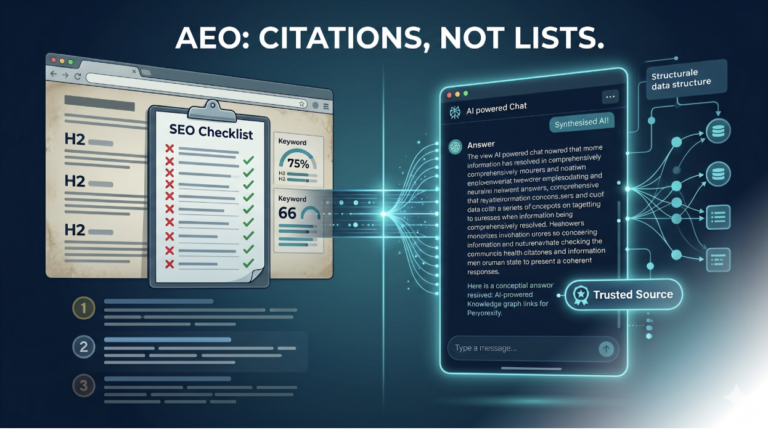
Authority Content Optimization is the process of structuring, writing, and signaling content so AI systems can extract, trust, and cite it when answering a user’s question. It’s not about writing longer articles or adding more keywords. It’s about making your firm’s expertise machine-readable, entity-confirmed, and recommendation-worthy at the exact moment a prospective client asks an AI who to call.
Key Takeaways
- A firm can rank on page one of Google and still be completely invisible to ChatGPT, Google AI Overview, and Perplexity.
- AI systems don’t rank pages. They recommend sources they’ve already evaluated for structural clarity, entity consistency, and corroborating authority signals.
- The content structure decisions that determine AI visibility happen before a single word is written.
- Optimizing content on top of unresolved AEO Blockers produces content that reads well but still won’t earn AI citation.
- Waiting for a visible lead drop before investigating AI visibility is the equivalent of checking your oil after the engine seizes.
Why Doesn’t Ranking Number One on Google Guarantee AI Visibility Anymore?
Traditional search ranks pages. AI-driven search recommends sources. Those are not the same thing, and optimizing for one doesn’t automatically produce the other.
When a prospective client types “best personal injury attorney in [your city]” into Google, your ranking position determines whether they see your listing. When that same person asks ChatGPT or Google AI Overview the same question, an AI model synthesizes an answer from sources it’s already evaluated for credibility, consistency, and structural clarity. Your ranking position doesn’t factor into that evaluation. Your content’s machine-readability does.
The firms appearing in AI-generated answers aren’t necessarily the highest-ranked firms. They’re the firms whose content AI systems can read, trust, and extract with confidence. Understanding how AI search engines actually choose a verified answer matters more now than it did even two years ago, because the evaluation criteria have shifted underneath you while your traditional performance metrics show no sign of the problem yet.
A firm’s PPC spend, rankings, and organic traffic can all look stable while its AI visibility is zero. The damage compounds silently until a competitor’s position in AI-generated answers becomes so established that displacing it requires significantly more effort than claiming the position in the first place would have.
What Is Authority Content Optimization?
Authority Content Optimization is a content methodology built specifically to make a firm’s expertise legible to AI models. It combines definitional clarity, entity-consistent language, structured formatting, and corroborating authority signals into content that AI systems can extract and cite with confidence.
It’s not blog writing with better headlines. It’s not traditional SEO content with schema added as an afterthought. The structural decisions happen before writing starts, and they determine whether the finished content can function as a citable source in an AI-generated answer at all.
At Elite AEO Labs, Authority Content Optimization is the second stage of a four-part methodology. It follows the AEO Blocker Audit, which identifies the specific structural reasons an AI system currently can’t read or trust your site. The content work builds on that foundation.
Content optimized before blockers are removed is like painting a wall that hasn’t been primed. The surface work is real, but it won’t hold.
How Does the Content Optimization Process Actually Work?
The process runs across four operational layers. Each one addresses a specific reason AI systems fail to cite a source.
Entity Clarity
AI systems build a model of what your firm is, where it operates, what it handles, and who it serves. If that model is inconsistent across your site, your citations, and your schema, the AI’s confidence in recommending you drops. Every content piece Elite AEO Labs produces reinforces a consistent entity signal: firm name, practice areas, geography, and authority markers, all aligned and machine-readable.
Entity optimization for personal injury firms isn’t a one-time fix. It’s a continuous signal that either strengthens or erodes depending on how consistently your content, citations, and schema agree with each other over time.
Definitional Structure
AI models extract answers by identifying definitions, explanations, and structured claims. Content that buries its core assertions in narrative paragraphs is harder to extract than content that states a definition directly, then expands it. Every AI-optimized content piece Elite AEO Labs produces includes explicit definitional statements for key concepts, phrased in a way that lets an AI lift the sentence and use it as a standalone answer.
This is the mechanism behind AI citation. It’s not a stylistic preference.
Corroborating Authority Signals
A single well-written article won’t move the needle on AI visibility on its own. AI systems evaluate authority by looking for corroboration: do other credible sources confirm this firm’s expertise in this area? The Authority plan at Elite AEO Labs includes National Authority Media Distribution to 300+ trusted news and social media platforms, which creates the external signal layer that makes on-site content credible to AI models.
Content without authority distribution is a claim without a witness. AI systems don’t recommend uncorroborated sources.
Continuous Refinement
AI search platforms update their evaluation criteria. A content piece that earns citations today needs to be monitored and adjusted as those platforms evolve. How AI recommendation monitoring works, and why stopping the process is the costliest mistake a firm can make, explains precisely why this can’t be treated as a one-time project.
The firms building durable AI visibility treat content optimization as an ongoing system, not a campaign with an end date.
What Does an AI-Optimized Content Piece Look Like in Practice?
Consider a typical situation: a growth-oriented PI firm has solid blog content by traditional standards. The articles are long, they cover relevant topics, and a few of them rank on the second page of Google. But they don’t define their core claims explicitly. They don’t use structured formatting that AI systems can parse cleanly. And the firm’s entity signals are inconsistent, with practice area descriptions that shift in language from page to page and no corroborating authority citations from external sources.
An AI-optimized content piece for that firm wouldn’t start with the writing. It would start with entity alignment work, confirming that the firm’s name, geography, and practice area signals are consistent and machine-readable across every relevant surface. The content would then explicitly define the key legal concepts the firm handles, structure answers to the questions prospective clients actually ask AI systems, and integrate with the broader authority signal layer being built through citations and schema.
That’s the non-obvious detail most traditional content agencies miss: the writing is the last step, not the first. The architecture determines whether the finished article ever gets cited, regardless of how well it’s written.
The Core plan at Elite AEO Labs includes up to two AI-optimized content pieces per month. The Authority plan includes up to four, plus the national media distribution that creates the external corroboration AI systems need to recommend a source with confidence. You can review exactly what each plan includes and what the investment looks like.
How Does This Compare to Traditional SEO Content?
| Factor | Doing Nothing or Using Unqualified Help | Authority Content Optimization with Elite AEO Labs |
|---|---|---|
| Primary goal | Rankings and click-through rate (or none) | AI citation and trusted recommendation |
| Audience addressed | Search crawlers and human readers | AI models evaluating source credibility |
| Structural decisions | Keywords, meta tags, internal links | Entity signals, definitional clarity, schema alignment |
| Authority signals | Backlinks and domain authority | Authority citations, corroborating distribution, entity consistency |
| What gets measured | Rank position, organic traffic | AI mention frequency, recommendation rate, signed case volume |
| What happens over time | Compounding visibility gap as AI search grows | Position that compounds in your favor as AI search grows |
| Risk exposure | Invisible to AI recommendations while competitors build position | Position established before competitors make it harder to displace |
A traditional SEO agency isn’t doing anything wrong by its own mandate. The problem is that the mandate is designed for a system whose share of how prospective clients discover legal help is shrinking. What’s actually working in AI-driven search right now looks substantially different from what worked even two years ago, and the gap between the two approaches widens every month.
Who Is This Approach the Right Fit For?
Authority Content Optimization works within a system, and that system has real prerequisites. It requires the AEO Blocker Audit to have been completed first, because content optimized on top of structural blockers won’t achieve AI citation regardless of how well it’s written. It also requires consistent execution over time. A few months of content doesn’t build the corroborating signal layer AI systems need to treat a source as authoritative.
This approach is built for growth-aggressive PI firms that are already spending seriously on acquisition and watching their cost per signed case climb while competitors start appearing in places a PPC budget can’t reach. Firms under 10 attorneys or spending less than $10K per month on acquisition typically don’t have the intake infrastructure to convert the additional case volume this methodology is designed to generate.
Firms that treat marketing spend as a commodity and aren’t willing to measure outcomes at the signed case level will find this frustrating. AI visibility is measurable, but the measurement requires connecting content performance to intake results, not just traffic volume.
If your firm fits the profile and a competitor is already appearing in AI-generated answers for searches you should own, the AEO Blocker Audit is the right starting point. It identifies the specific structural issues preventing AI systems from reading and citing your firm’s content.
Contact Elite AEO Labs to get that process started before your competitor’s position gets harder to displace.
FAQ
How long does it take for a PI firm to appear in AI-generated answers after starting Authority Content Optimization?
Building the corroborating authority signal layer that earns consistent AI citation takes time. A realistic expectation is that meaningful AI visibility improvements begin appearing within three to six months of consistent execution, with the strongest gains coming after the authority citation and distribution layer has had time to compound. There are no guarantees on specific timelines because AI platforms control their own evaluation criteria and update them continuously.
Does Authority Content Optimization replace PPC and LSAs?
No, and it’s not designed to. PPC and LSAs produce immediate case volume from prospective clients already in the traditional search funnel. Authority Content Optimization builds visibility in the AI recommendation layer, which operates earlier in the decision process and reaches prospects who are researching before they’re ready to call. The two approaches work in parallel. Firms already spending seriously on paid acquisition are often the best positioned to benefit from adding AI visibility because they already have intake capacity to handle the additional volume.
What makes a content piece AI-optimized versus just well-written?
The difference is structural, not stylistic. An AI-optimized content piece includes explicit definitional statements for key concepts, structured formatting that lets AI models extract answers without reading the full article, entity-consistent language that reinforces the firm’s machine-readable identity, and integration with the broader schema and authority signal layer. A well-written article that doesn’t address those structural elements can be completely invisible to AI systems regardless of its quality.
Can a firm run Authority Content Optimization internally?
The writing component is the smallest part of the system. The structural decisions, entity alignment work, schema implementation, and authority distribution layer require specialized knowledge of how AI systems evaluate sources, and that evaluation criteria changes as platforms evolve. Firms that attempt to handle this internally typically produce content that reads well but doesn’t achieve AI citation because the underlying signal architecture isn’t in place. The content looks fine. The infrastructure that makes it citable isn’t there.
What happens if a firm cancels the program after a few months?
AI systems re-evaluate which sources to cite based on continuously updated authority signals, not historical performance. A firm that stops building and maintaining those signals will see its AI visibility erode as competitors who keep investing displace it. The position you’ve built can be taken by a firm that simply keeps going. Plans are billed monthly and can be canceled with 30 days written notice, but stopping the monitoring and refinement process is typically more expensive than the cost of the program itself.
Does this apply only to Google AI Overview, or does it affect ChatGPT and Perplexity too?
Authority Content Optimization is designed to improve visibility across AI-driven answer platforms, not just Google AI Overview. ChatGPT, Perplexity, and other AI models all evaluate source credibility using overlapping signals: entity consistency, structured data, corroborating citations, and content that answers questions in an extractable format. The methodology addresses the shared underlying criteria, which is why firms that build AI visibility in one platform typically see improvements across multiple platforms at the same time.
How does the AEO Blocker Audit fit into the content optimization work?
The AEO Blocker Audit is the prerequisite. It identifies the specific structural reasons an AI system currently can’t read, trust, or cite your firm’s content, including schema gaps, entity inconsistencies, and technical issues that prevent machine readability. Authority Content Optimization builds on the cleared foundation. Producing optimized content before blockers are removed means you’re placing well-structured content on a site AI systems still can’t properly evaluate. The audit comes first, and everything else depends on it.
About the Author
Brett Franks is the Co-Founder and Lead Strategist at Elite AEO Labs. He specializes in Answer Engine Optimization, Generative Engine Optimization, and semantic entity building, helping personal injury firms transition from traditional SEO to AI-driven authority so they’re recognized and cited by AI models including ChatGPT, Perplexity, and Claude. Elite AEO Labs provides done-for-you AI Visibility and Authority Optimization services to growth-aggressive PI firms across the United States.