According to Gartner, organic search traffic is projected to decline by 25% by 2026 as AI-powered interfaces intercept queries before users ever reach a results page. If your firm is still measuring success by keyword rankings and click-through rates, you are measuring the wrong thing entirely.
What Is Answer Engine Optimization – and Why Does It Replace Traditional SEO?
Answer Engine Optimization (AEO) is the practice of structuring content, authority signals, and entity data so that AI systems – not search algorithms – select your business as the trusted source in a generated response. Unlike traditional SEO, which optimizes for ranking position in a list, AEO optimizes for inclusion in a synthesized answer. The distinction matters because AI systems do not distribute traffic. They resolve queries. If you are not the resolution, you are invisible.
Key Takeaways
• Ranking #1 in Google does not guarantee – or even correlate with – appearing in AI-generated answers from ChatGPT, Perplexity, or Google’s AI Mode.
• AEO Blockers are structural and semantic gaps that prevent AI systems from reading, trusting, and citing your content – most firms have several and do not know it.
• Authority signals and entity recognition, not keyword density, determine whether AI systems recommend your business.
• Checklists and formatted content satisfy crawlers; they do not satisfy AI synthesis engines that evaluate conceptual completeness and source credibility.
• Firms that address AEO Blockers before their competitors do will establish citation patterns that compound over time – those that wait will find AI systems have already formed preferences.
Why Is Your Firm Invisible in AI Search Even Though You Rank on Google?
This is the question most marketing directors ask about six months too late.
Google rankings and AI visibility are not the same system. They never were. Google’s algorithm rewards relevance signals – backlinks, keyword match, page authority. AI synthesis engines like ChatGPT, Perplexity, and Google’s AI Mode operate on a different logic entirely. They are trained to identify trustworthy, authoritative, and structurally coherent sources that can be cited with confidence.
A firm can hold the #1 position in Google for a competitive keyword and never appear once in an AI-generated answer for the same query.
That is not a ranking problem. It is a structural problem – and it requires a different kind of fix.
“Traditional SEO was a race to the top of a list. AEO is about being in the room before the race starts.”
What Are AEO Blockers and Why Do Most Firms Have Them?
An AEO Blocker is any technical, structural, or semantic condition that prevents an AI system from recognizing, trusting, or citing a business as a credible source in a generated response.
The reason most firms have them is not negligence. It is timing. The entire infrastructure of modern marketing – content strategy, SEO audits, site architecture – was built around satisfying search crawlers. Crawlers reward formatting. AI synthesis engines reward coherence, entity clarity, and verifiable authority.
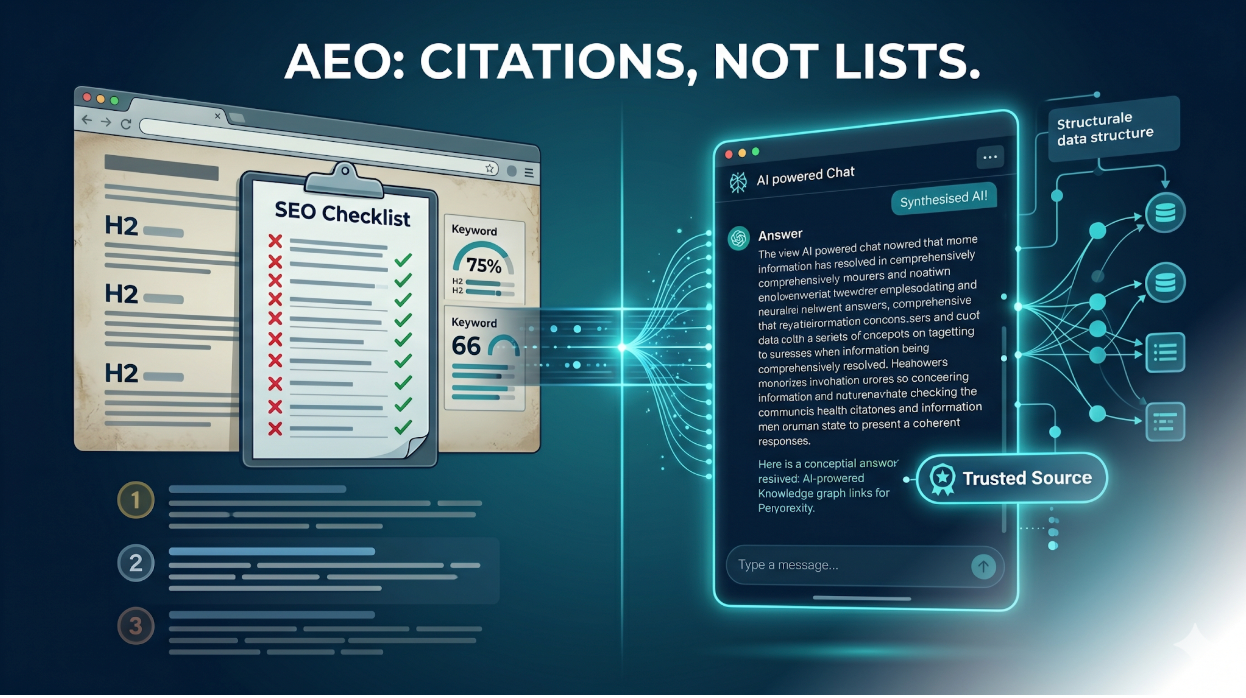
A well-formatted checklist article with proper H2 tags and keyword density scores well in a crawler audit. That same article may be completely opaque to an AI system that is trying to determine whether your firm is a recognized entity in its domain, whether your claims are structurally consistent with what other trusted sources say, and whether your content resolves a query or merely addresses it.
These are different tests. Most sites are only prepared for one of them.
At Elite AEO Labs, the AEO Blocker Audit exists specifically to surface these gaps – not as a theoretical exercise, but as a prioritized list of what is preventing AI recommendation right now. Understanding what answer engine optimization services do for a business is often the first step toward recognizing how deep these gaps run.
Why Do Checklists Fail AI Search – Specifically?
This is worth being precise about, because the answer is not obvious.
Checklists fail AI search not because they are poorly written. They fail because they are structurally ambiguous to a synthesis engine. A checklist tells a crawler: “this content is organized and scannable.” It tells an AI model almost nothing about whether the source behind it is authoritative, whether the claims are grounded in demonstrated expertise, or whether the entity producing it is recognized within a knowledge domain.
AI systems are trained to resolve queries, not to reward formatting.
The causal mechanism here matters. When a user asks ChatGPT or Perplexity a question, the model is not retrieving the highest-ranked page. It is synthesizing an answer from sources it has determined are credible, coherent, and relevant to the specific query. Credibility is evaluated through entity signals – structured data, schema markup, consistent entity references across the web, and semantic alignment between what a source claims and what the broader knowledge graph confirms.
A checklist article with no schema markup, no entity disambiguation, and no structured authority signals is, from an AI model’s perspective, noise.
The AEO Signal Stack: A Framework for AI Visibility
The AEO Signal Stack is a three-layer framework for diagnosing why a business is absent from AI-generated answers and what to fix first.
Layer 1 – Technical Readability: Does the site’s structure allow AI systems to parse, extract, and attribute content accurately? This includes schema markup, structured data, and entity disambiguation. Without this layer, nothing above it matters.
Layer 2 – Authority Signals: Is the business recognized as an entity across multiple credible, external sources? AI systems cross-reference. A firm that exists only on its own website is not yet a trusted entity – it is a claim without corroboration.
Layer 3 – Conceptual Completeness: Does the content answer the full query – including the follow-up questions a user would naturally ask – or does it answer one dimension and stop? AI synthesis engines favor sources that resolve queries comprehensively, not sources that optimize for a single keyword.
Use this framework when: auditing an existing site for AI visibility gaps, prioritizing which fixes to address first, or evaluating whether a content strategy is AEO-ready.
Do not use it as a publishing checklist. It is a diagnostic tool, not a content template.
What Does the Shift from SEO to AEO Actually Look Like in Practice?
Two scenarios illustrate the difference.
A regional accounting firm had maintained first-page Google rankings for competitive tax advisory keywords for several years. When their marketing director began tracking AI-generated answers for the same queries, the firm appeared in fewer than one in twenty responses across ChatGPT and Perplexity – despite strong domain authority and consistent content output. The issue was not content volume. It was entity opacity. The firm had no structured data connecting their practitioners to recognized credentials, no schema markup attributing their content to a named entity, and no consistent external citation pattern. After addressing these AEO Blockers through a structured remediation process, AI citation frequency increased measurably within four months.
A mid-size B2B software agency faced a different version of the same problem. Their blog content was well-optimized for traditional SEO – keyword-rich, formatted for scannability, regularly updated. None of it was structured for AI synthesis. When they ran an AEO Blocker Audit through Elite AEO Labs, the audit identified seventeen distinct blockers, the most critical being the absence of any entity-level schema and a content architecture that answered surface questions without resolving the underlying query. Remediation took approximately six months to show consistent AI citation patterns, but the firm began appearing in Perplexity answers for competitive queries within the first ninety days of structured remediation.
How Does AEO Compare to Traditional SEO – and What Are the Real Tradeoffs?
| Dimension | Traditional SEO | Answer Engine Optimization (AEO) |
| Primary goal | Rank in search results | Be cited in AI-generated answers |
| Success metric | Keyword position, click-through rate | AI citation frequency, recommendation rate |
| Core signals | Backlinks, keyword density, page speed | Entity recognition, schema markup, authority signals |
| Content format | Optimized for crawlers and scanners | Optimized for AI synthesis and query resolution |
| Timeline to results | 3-6 months typical | 3-9 months depending on blocker severity |
| Dependency | Google algorithm updates | AI model training and retrieval patterns |
| Risk of invisibility | Ranking drops | Complete absence from AI-generated answers |
The honest tradeoff: AEO does not replace the need for a functional, well-structured website. Technical SEO fundamentals still matter – they are the floor, not the ceiling. What AEO addresses is the ceiling that traditional SEO cannot reach. The key differences between AI search and traditional SEO go deeper than most marketing teams realize until they have already lost ground.
“If your entire visibility strategy depends on people clicking through to your site, you are building on a foundation that is quietly being removed.”
Who Is This Approach Not Right For?
AEO is not the right investment for every business at every stage.
If your business has no existing web presence, no content foundation, and no defined service offering, AEO remediation will not produce meaningful results. The AI Signal Stack requires something to work with – entity signals cannot be built from nothing.
If your market is entirely referral-driven with no search component, AI visibility optimization is a low-priority investment relative to other growth levers.
And if your team is not prepared to make structural changes to site architecture, content strategy, and schema implementation, an audit without execution produces no outcome. Elite AEO Labs offers managed remediation for this reason – but the commitment to structural change has to exist on the client side.
AEO does not accelerate a broken content strategy. It makes a credible content strategy visible to AI systems that would otherwise ignore it.
FAQ: Real Questions About AEO from Marketing Directors and Business Owners
Does my Google ranking affect whether I appear in AI answers?
Not directly. Google rankings and AI citation are separate systems with different evaluation criteria. A strong Google ranking indicates relevance to a crawler algorithm; AI systems evaluate entity credibility, structural coherence, and authority signals. The two can correlate, but ranking well in Google does not cause AI visibility – and the gap between them is widening.
How long does it take to start appearing in AI-generated answers after fixing AEO Blockers?
Practitioners report that technical fixes – schema markup, structured data, entity disambiguation – can produce measurable changes in AI citation frequency within sixty to ninety days. Full authority signal development typically takes four to nine months depending on the severity of existing blockers and the competitiveness of the market.
What exactly is a schema markup and why does it matter for AI search?
Schema markup is structured data added to a website that explicitly tells AI systems and search engines what a page is about, who produced it, and what entity it represents. Without it, AI systems must infer – and inference is unreliable. Schema markup removes ambiguity, which is why it is one of the highest-priority AEO Blockers Elite AEO Labs addresses in every audit.
Is AEO something I can do myself, or does it require a specialist?
Some elements – basic schema implementation, content restructuring – can be handled in-house with technical resources. The diagnostic work, specifically identifying which AEO Blockers are most damaging and in what order to address them, requires pattern recognition across AI retrieval behavior that most internal teams have not yet developed. The cost of misdiagnosis is months of remediation effort applied to the wrong problem.
What AI platforms does AEO optimization actually affect?
The primary platforms where AEO visibility matters right now are ChatGPT, Perplexity, Google AI Mode, and Claude. Each has different retrieval patterns, but the underlying signals – entity recognition, structured data, authority corroboration – are consistent across all of them. Optimizing for one does not hurt performance on others.
Will AI search platforms eventually replace Google entirely?
Gartner’s projection of a 25% decline in organic search traffic by 2026 suggests displacement, not replacement – at least in the near term. The more precise framing is that AI-generated answers are intercepting a growing share of queries that would previously have driven traffic to websites. Firms that depend on that traffic without an AEO strategy are already experiencing the effect.
What is the difference between AEO and GEO (Generative Engine Optimization)?
Generative Engine Optimization (GEO) is a term used specifically for optimizing content to appear in generative AI outputs. AEO – Answer Engine Optimization – is the broader practice that includes GEO but also encompasses entity optimization, authority signal development, and technical structure. Elite AEO Labs uses AEO as the governing framework because it addresses the full system, not just content formatting for generative outputs.
What Should You Do Right Now If Your Firm Is Invisible in AI Search?
The firms that establish AI citation patterns in 2025 will be the default recommendations by 2026. That is not a prediction. It is how AI model training works – early citation patterns compound, and late entrants face an increasingly crowded field of already-established entities.
“Checklists and keyword-optimized content satisfy crawlers. They do not satisfy AI synthesis engines that are evaluating whether your firm is worth citing.”
If you have been ranking well in Google and wondering why you never appear in AI-generated answers, the answer is almost certainly a set of AEO Blockers you have not yet identified.
Download the full AEO Strategy Guide today. It walks through the complete AEO Signal Stack, the most common blockers Elite AEO Labs identifies in audits, and the exact sequence for addressing them – from technical readability through authority signal development. This is the document to share with your marketing director or SEO manager before your next strategy conversation.
Download the Full AEO Strategy Guide
About the Author
Brett Franks is the Co-Founder and Lead Strategist at Elite AEO Labs, where he focuses on helping businesses transition from traditional SEO to AI Visibility Authority Optimization. He specializes in Generative Engine Optimization and semantic entity building, developing structured frameworks that secure brand visibility across AI platforms including ChatGPT, Perplexity, and Claude. Elite AEO Labs works with professional service firms and agencies in moderate to high-competition markets through its Core and Authority tier programs.
References
Gartner – Research on projected decline in organic search traffic through 2026, covering AI-driven search disruption trends.