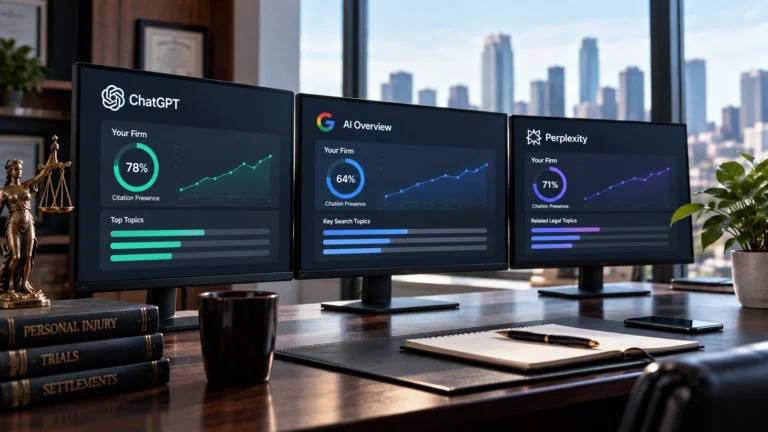
Your firm ranks well. You have the backlinks, the optimized pages, the consistent content cadence. And yet when someone asks ChatGPT or Perplexity to recommend a firm in your category, your name does not appear. A competitor you have outranked for years does.
That gap is not a ranking problem. It is an authority recognition problem – and the systems creating it operate on entirely different logic than Google.
What Does It Actually Mean to Be a Verified Source in AI Search?
AI search authority is the condition in which AI systems – including ChatGPT, Perplexity, Google AI Overviews, and Claude – consistently identify, retrieve, and cite a business as a trusted source when generating answers to relevant queries. It is not determined by keyword rankings. It is determined by how clearly a business’s entity, expertise, and structured signals are legible to AI retrieval systems. Businesses that achieve this are recommended. Those that do not are invisible – regardless of their Google position.
Key Takeaways
• AI systems do not rank pages – they resolve queries by citing sources they can verify. Being #1 in Google does not make you a verified source.
• FAQSchema and structured data are not formatting choices – they are the signals that make your content directly retrievable by AI synthesis engines.
• Entity optimization means establishing your firm as a clearly defined, consistently referenced concept across the web – not just a URL.
• AEO Blockers are specific structural and authority gaps that prevent AI systems from recognizing and recommending your business.
• Building AI search authority is a 6-12 month process with measurable milestones – not an overnight fix or a one-time audit.
Why Does Ranking #1 in Google No Longer Guarantee AI Visibility?
Here is the contrarian claim, stated plainly: high Google rankings can create a false sense of security that actively delays the structural changes needed to survive AI-driven search.
Firms that rank well have evidence that their current approach works. That evidence is now misleading them.
Google’s ranking algorithm rewards relevance signals – backlinks, keyword density, page authority. AI retrieval systems operate differently. They are trained to resolve queries by synthesizing information from sources they can verify as authoritative, structured, and entity-consistent. A page that ranks because it has 200 backlinks may never appear in an AI-generated answer if its entity signals are ambiguous, its structured data is absent, or its content is formatted for crawlers rather than synthesis.
AI systems are trained to resolve queries, not to distribute traffic. The entire premise of traditional SEO – earn clicks by ranking high – does not apply to a system that answers the question without sending anyone anywhere.
The mechanism matters here. When a user asks ChatGPT “which accounting firm in Denver handles multi-state tax compliance,” the model is not consulting a ranked list. It is drawing on its training data and retrieval layer to identify entities it has encountered consistently, described precisely, and associated with that specific capability. If your firm’s digital presence does not clearly establish that entity relationship, you do not exist in that answer – even if you rank on page one for the exact keyword phrase. Understanding how AI search engines recommend businesses makes clear why entity clarity, not keyword dominance, determines who gets cited.
What Are AEO Blockers and Why Do Most Firms Have Them Without Knowing?
AEO Blockers are specific structural, technical, and authority gaps in a business’s digital presence that prevent AI systems from identifying, verifying, and recommending that business in generated answers.
Most firms have them. Not because they have done something wrong, but because their entire digital infrastructure was built for a different system.
The most common AEO Blockers practitioners identify include: missing or incomplete FAQSchema markup, inconsistent entity naming across platforms, absence of structured data on key service pages, thin or non-synthesizable content on core topic areas, and weak or absent third-party entity references in knowledge graphs.
Consider a real pattern from the field. A mid-sized consulting firm had invested three years building topical authority in their niche. Strong domain rating, consistent publishing cadence, first-page rankings across 40+ target terms. When their marketing director ran queries through ChatGPT and Perplexity, a smaller competitor – one with a fraction of the backlink profile – appeared in nearly every relevant AI-generated answer. The difference was structural: the competitor had implemented FAQSchema across service pages, maintained consistent entity descriptions across Google Business Profile, LinkedIn, and their website, and had earned citations in several industry directories that AI models treat as trust signals. The larger firm had none of these. Their authority was invisible to the systems that now matter most.
That is what an AEO Blocker audit surfaces. Elite AEO Labs built their diagnostic process specifically around identifying these gaps – not as a generic SEO review, but as a structured assessment of AI retrieval readiness.
How Does Structured Content Actually Signal Authority to AI Systems?
FAQSchema is a structured data format that explicitly marks up question-and-answer content on a webpage, making it directly parseable by AI retrieval systems without requiring inference or interpretation.
This distinction matters more than most firms realize. AI synthesis engines do not read pages the way humans do. They extract structured signals. A paragraph that answers a question well is useful. That same answer wrapped in FAQSchema is unambiguous – the system knows exactly what question is being answered and what the authoritative response is.
The same logic applies to entity optimization. Entity optimization is the process of establishing a business as a clearly defined, consistently described concept across all digital touchpoints – website, directories, knowledge graphs, third-party citations – so AI systems can recognize and reference it with confidence.
When your firm’s name, service description, geographic scope, and expertise signals are consistent across your website, Google Business Profile, LinkedIn, Crunchbase, industry directories, and external citations, AI models encounter the same entity repeatedly. Repetition across trusted sources is how AI systems develop confidence in a recommendation. Inconsistency – even minor variations in how your firm describes its services – introduces ambiguity that causes AI systems to default to sources they can verify more cleanly.
Traditional SEO was a race to the top of a list. AEO is about being in the room before the race starts.
The second contrarian observation worth sitting with: most businesses assume their content quality is the primary barrier to AI visibility. It is usually their content structure. A well-written, deeply researched page with no schema markup, no entity consistency, and no retrievable Q&A format will consistently lose to a thinner page that is structurally legible to AI systems. This is precisely how AEO services improve AI Overviews and ChatGPT rankings – by closing the structural gaps that keep well-resourced firms invisible in generated answers.
What Does a Realistic AEO Growth Timeline Look Like?
No credible practitioner should promise AI citation results in 30 days. The mechanism does not work that way.
AI models are updated on training cycles, and retrieval layers are influenced by accumulated authority signals over time. Practitioners working with Elite AEO Labs’s methodology report a realistic timeline of 6-12 months for measurable AI visibility improvements in moderate-competition markets, with early structural wins – schema implementation, entity consistency corrections, AEO Blocker resolution – visible in audit tools within the first 60-90 days.
Here is what that looks like in practice. A professional services firm entering Elite AEO Labs’s Core tier program (designed for moderate-competition markets) would typically see the following arc: Month 1-2 focuses on the AEO Blocker Audit and technical remediation – schema deployment, entity signal alignment, structured content restructuring. Month 3-5 shifts to authority building – earning citations in AI-trusted directories, developing synthesizable FAQ content across service pages, and strengthening knowledge graph signals. Month 6 onward is monitoring and expansion – tracking AI citation frequency across platforms, identifying new query categories to own, and layering in additional entity associations.
The Authority tier (for high-competition markets) follows the same arc but with deeper competitive analysis and broader citation network development.
| Milestone | Core Tier Timeline | Authority Tier Timeline |
| AEO Blocker Audit complete | Week 2-3 | Week 2-3 |
| Schema + entity corrections deployed | Month 1-2 | Month 1-2 |
| First measurable AI citation signals | Month 3-5 | Month 4-6 |
| Consistent AI recommendation presence | Month 6-9 | Month 8-12 |
| Competitive category ownership | Month 9-12 | Month 12+ |
Who Is This Approach Not Right For?
Honest answer: AEO optimization is not the right investment for every business right now.
If your business operates in a hyper-local market with minimal competition and your leads come primarily from referrals, the urgency is lower. AI search disruption is real, but it hits hardest in markets where buyers are actively researching options before making contact – professional services, agencies, B2B firms, financial services, legal, consulting.
If your website is technically broken – slow load times, crawl errors, no mobile optimization – those foundational issues need resolution before AEO work will hold. Elite AEO Labs’s audit process will surface these, but the remediation sequence matters.
And if you are expecting AEO to replace a broken lead generation strategy, it will not. AI search authority makes you visible to buyers who are already looking. It does not manufacture demand that does not exist.
Frequently Asked Questions
How is AEO different from the SEO I am already doing?
Traditional SEO optimizes for ranking position in a list of results. AEO optimizes for being cited as a trusted source in AI-generated answers – a system that does not produce ranked lists at all. The signals that drive each are different: SEO rewards backlinks and keyword relevance; AEO rewards entity clarity, structured data, and consistent authority signals across the web.
If I already rank well in Google, why am I not appearing in AI answers?
Google rankings and AI citation are built on different signals. A strong backlink profile and keyword-optimized content satisfy Google’s algorithm but do not make your content retrievable by AI synthesis engines. AI systems need structured, unambiguous signals – FAQSchema, entity consistency, synthesizable content – that most high-ranking sites were never built to provide.
How long before I start seeing my firm recommended in AI search results?
Practitioners consistently report that early structural improvements – schema deployment, entity corrections – are detectable in audit tools within 60-90 days. Measurable AI citation presence in moderate-competition markets typically develops over 6-9 months. High-competition markets require 8-12 months for consistent AI recommendation presence.
What exactly is an AEO Blocker Audit and what does it find?
An AEO Blocker Audit is a structured diagnostic that identifies the specific gaps preventing AI systems from recognizing and recommending your business. It surfaces missing or broken schema markup, entity naming inconsistencies, content that is not structured for AI retrieval, weak knowledge graph signals, and gaps in third-party citation coverage. It is the starting point for any AEO engagement at Elite AEO Labs.
Does AEO work for local businesses or only national brands?
AEO works at any geographic scale, but the urgency and complexity differ. Local professional service firms in mid-size to large metros are among the most affected by AI search disruption – buyers in those markets are actively using AI tools to find and vet providers. Elite AEO Labs’s Core tier was built specifically for moderate-competition markets where local authority signals are the primary lever.
Will AI search keep growing or could this be a short-term trend?
Industry analysts at Gartner have projected significant declines in traditional search engine volume as AI-generated answers absorb query traffic. The underlying shift – from link-based retrieval to AI synthesis – is structural, not cyclical. Businesses that build AI search authority now are establishing durable positioning; those waiting for the trend to stabilize are ceding ground that becomes harder to recover.
What happens to my Google rankings if I shift focus to AEO?
AEO optimization does not conflict with Google rankings – many of the structural improvements that increase AI visibility also strengthen traditional SEO signals. Schema markup, content clarity, entity consistency, and authoritative citations benefit both systems. The risk is not in doing AEO. The risk is in treating Google rankings as the only metric that matters while AI search quietly absorbs your category.
If Your Firm Is Not in the AI Answer, You Are Not in the Conversation
The firms that will own their categories in AI-driven search are not necessarily the ones with the biggest budgets or the longest track records. They are the ones that become structurally legible to AI systems first.
That is the only insight in this article worth bookmarking: in AI search, clarity of structure is the new competitive moat – not the size of your content library.
If you have read this far, you are already asking the right questions. The next step is finding out exactly what is blocking your firm from AI visibility – and that starts with an audit, not a guess.
Schedule an AEO growth consultation with Elite AEO Labs today. You will leave the call with a clear picture of your current AI visibility gaps, which AEO Blockers are most likely holding you back, and what a realistic remediation timeline looks like for your market. Not a sales pitch. A diagnostic conversation with a strategist who has done this work.
Schedule your AEO growth consultation at eliteaeolabs.com
About the Author
Brett Franks is the Co-Founder and Lead Strategist at Elite AEO Labs, where he specializes in Answer Engine Optimization (AEO) and Generative Engine Optimization (GEO) for professional service firms navigating the shift from traditional search to AI-driven visibility. He develops data-driven frameworks for semantic entity building and knowledge graph authority, helping brands become recognized and cited by AI models including ChatGPT, Perplexity, and Claude. Elite AEO Labs works with firms in moderate to high-competition markets seeking to adapt and dominate as AI search replaces traditional Google rankings.
References
Gartner – Research covering projected declines in traditional search engine volume and the growth of AI-generated answer consumption. Referenced for analyst framing on AI search adoption trajectory.