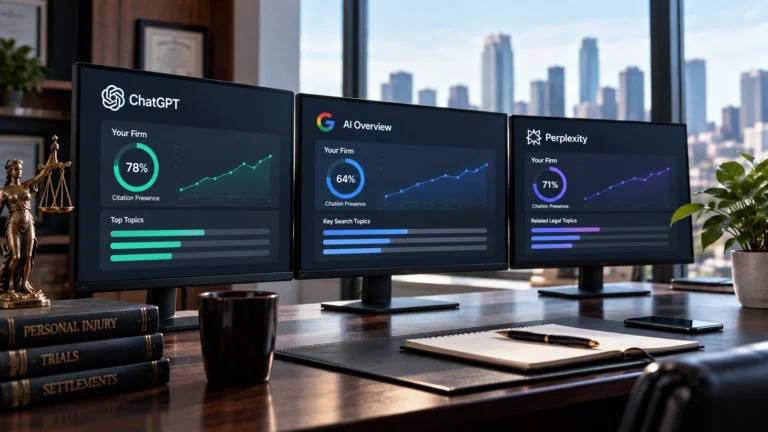

Your Google rankings look fine. Traffic is holding. And yet when someone asks ChatGPT, Perplexity, or Google’s AI Mode to recommend a firm like yours, your name doesn’t appear. That gap isn’t a coincidence – it’s a structural problem, and it compounds every month you don’t address it.
AEO optimization – Answer Engine Optimization – is the process of restructuring a business’s digital presence so AI systems can identify it as a trusted, citable source when generating answers to user queries. It’s not a variation of SEO. It operates on different signals, different architecture, and a fundamentally different logic about what “visibility” means.
Key Takeaways
• Ranking #1 in Google doesn’t make you visible to AI systems – they use authority signals, entity clarity, and structured data, not position.
• AEO Blockers are specific structural problems that prevent AI systems from recognizing and recommending your business.
• The AEO Blocker Audit is the diagnostic starting point – it identifies what’s preventing AI citation before any optimization begins.
• Entity signals and schema markup are the technical foundation AI systems use to verify a business as a credible source.
• Results from AEO optimization typically emerge over weeks to months – not overnight, and not through shortcuts.
Why Does Being #1 in Google No Longer Guarantee AI Visibility?
Here’s the uncomfortable truth most SEO managers don’t want to sit with: AI systems don’t consult your rankings. They consult your authority signals.
When ChatGPT or Google AI Mode generates an answer, it’s not pulling the top-ranked page. It’s identifying the source it can most confidently verify as accurate and credible. That determination is based on entity clarity, structured data, cross-source consistency, and topical authority – none of which are measured by your position in a SERP.
A firm can hold the top organic spot for a competitive keyword and still be completely absent from AI-generated answers. That’s not a ranking problem. It’s a recognition problem. The AI simply doesn’t know who you are with enough confidence to cite you.
This is the question most marketing directors ask about six months too late: “Why isn’t our firm showing up in AI answers?”
You can read more about how AI search engines actually choose which businesses to recommend – the mechanism is worth understanding before you try to optimize for it.
What Are AEO Blockers and Why Do They Matter?
AEO Blockers are specific, diagnosable structural problems in a business’s digital presence that prevent AI systems from recognizing it as a trustworthy, citable source.
They’re not vague. They’re not “your content could be better.” They’re technical and architectural failures – missing or malformed schema markup, inconsistent entity signals across platforms, unresolved brand ambiguity, thin topical coverage in key subject areas, and authority gaps that make AI systems uncertain about who you are and what you actually do.
The reason most firms have AEO Blockers isn’t negligence. It’s that traditional SEO never required solving these problems. Google’s ranking algorithm could work around a lot of structural messiness. AI retrieval systems can’t. They need clean, consistent, machine-readable signals – and most websites weren’t built to provide them.
Consider a typical case: a mid-sized consulting firm with strong organic rankings, a well-maintained blog, and solid backlinks. When their name is queried in AI systems, the responses are either vague or omit them entirely. The diagnosis almost always reveals the same cluster of issues – inconsistent NAP data across directories, schema markup that’s present but incorrectly implemented, and no clear entity definition connecting the firm’s expertise to a specific subject domain. Every one of those is a fixable AEO Blocker. Understanding how AI search has fundamentally changed from traditional SEO makes clear why these structural issues were invisible under the old model.
How Does the AEO Blocker Audit Actually Work?
The AEO Blocker Audit is the diagnostic foundation of everything Elite AEO Labs does. Before any optimization work begins, you need to know exactly what’s blocking your AI visibility – not a general sense of it, a specific inventory.
The audit examines your technical structure, entity signals, authority footprint, and content architecture against the criteria AI systems use to evaluate sources. It surfaces the specific gaps that are preventing citation. That’s the starting point.
This matters because optimization without diagnosis is just guessing. You could spend months improving content that isn’t the problem, while the actual blocker – a schema conflict, an entity disambiguation issue – stays untouched. The audit eliminates that waste.
If you want to understand what AEO services actually do for a business before committing to an audit, that context is worth having.
What Does Entity Optimization Actually Mean?
Entity optimization is the process of making a business’s identity, expertise, and relationships legible to AI knowledge systems – not just to search crawlers.
This is where most firms are structurally weakest and don’t know it. AI systems like ChatGPT and Perplexity don’t just read your website. They cross-reference your presence across multiple sources – structured databases, third-party mentions, directory listings, social profiles, and linked data – to build a coherent picture of who you are.
If those signals are inconsistent, incomplete, or contradictory, the AI’s confidence in citing you drops. It doesn’t flag the problem. It just doesn’t recommend you.
Entity optimization resolves that. It establishes a clear, consistent, machine-readable identity – what your firm does, who it serves, where it operates, and what subject domains it holds authority in. That clarity is what allows an AI system to confidently include you in a generated answer.
The technical side of how AI search engines verify businesses as trusted sources explains why this cross-referencing process is so consequential.
What Role Does Structured Data Schema Play?
Structured data schema is the markup language that makes your website’s content machine-readable – allowing AI systems to extract precise, verified facts rather than inferring them from prose.
Without it, an AI reading your homepage has to guess what you do, where you operate, and whether you’re credible. With correctly implemented schema, it knows. That’s not a small distinction.
Schema markup is not a ranking signal. It’s a trust signal. AI systems use it to confirm that the entity they’re reading about matches the entity they’ve seen referenced elsewhere. When that confirmation happens consistently, citation follows.
Most implementations Elite AEO Labs encounters are either missing entirely or technically present but incorrectly structured – wrong schema types, missing required fields, or markup that contradicts the page’s actual content. Each of those is an AEO Blocker in its own right.
For a deeper look at how AEO services affect AI Overviews and ChatGPT visibility, the schema layer is central to that explanation.
What Does the Optimization Process Look Like After the Audit?
Once AEO Blockers are identified, the work moves in a specific sequence. Technical fixes come first – schema implementation, entity signal alignment, NAP consistency across directories. These are the foundation. Nothing else works reliably until these are clean.
Content architecture comes next. This isn’t about publishing more. It’s about structuring what exists so AI systems can extract clear, authoritative answers from it. That means topical depth in the subject areas where you want to be cited, question-and-answer structures that match how AI systems retrieve information, and content that demonstrates genuine expertise rather than keyword coverage.
Authority signal development runs in parallel – building the cross-source presence that AI systems use to verify credibility. That includes third-party citations, structured mentions, and the kind of entity reinforcement that makes an AI confident enough to recommend you by name.
A common scenario: a professional services firm in a mid-size market completes the audit, resolves their technical blockers in the first month, and begins seeing their firm cited in AI-generated answers within the following two to three months as authority signals accumulate. That’s a realistic timeline – not a guarantee, but a typical pattern when the underlying work is done correctly.
If you’re weighing whether AI search optimization connects to actual business growth, that’s the right question to ask before starting.
How Does AEO Optimization Compare to Doing Nothing or Staying SEO-Only?
| Approach | AI Visibility | Risk Profile | Timeline |
| AEO Optimization with Elite AEO Labs | Builds AI citation through entity, schema, and authority signals | Addresses the structural gap before it compounds | Weeks to months, depending on market and blockers |
| Traditional SEO only | No direct AI citation benefit – different signal set | Rankings hold until AI adoption shifts user behavior further | Diminishing returns as AI Mode usage grows |
| Waiting / doing nothing | Zero AI presence | Compounding invisibility as competitors optimize | Each month of delay is a month of lost ground |
The firms that are being recommended in AI-generated answers right now didn’t get there by accident. They got there because they solved the structural problems their competitors haven’t found yet.
Waiting feels like a neutral choice. It isn’t. Every month a competitor resolves their AEO Blockers and you don’t is a month they’re accumulating AI citation history that’s harder to displace later. The future of zero-click search makes clear that this shift in how users find answers is not reversing.
Who Is This Not Right For?
Straight talk: AEO optimization isn’t the right investment for every situation.
If your business has no digital presence to optimize – no website, no consistent brand identity across platforms – the foundational work needs to happen before AEO can do anything meaningful. You can’t optimize signals that don’t exist.
If you’re in a market where your customers aren’t yet using AI-driven search to find providers, the urgency is lower. That window is closing, but it’s not uniform across every industry and geography.
And if you’re expecting a one-month fix that produces immediate citation, that’s not what this is. AEO optimization builds authority over time. The firms that get the most from it are the ones who treat it as infrastructure, not a campaign.
Elite AEO Labs offers two tiers – Core for moderate-competition markets and Authority for high-competition markets – because the depth of work required is genuinely different. The full breakdown of what’s included in each package is worth reviewing if you’re evaluating fit.
If your firm is ranking in Google but invisible in AI-generated answers, the AEO Blocker Audit is the right starting point. It tells you exactly what’s blocking your visibility and what it takes to fix it – before the gap between you and your AI-visible competitors gets any wider.
Contact Elite AEO Labs to request your AEO Blocker Audit and find out what’s standing between your firm and AI citation.
FAQ
Why isn’t my firm showing up in ChatGPT or Google AI answers even though we rank well in Google?
AI systems don’t use search rankings to select sources. They use entity signals, structured data, and cross-source authority to determine which businesses they can confidently cite. A strong Google ranking means your SEO is working – it doesn’t mean your AI visibility signals are in place.
How long does it take to see results from AEO optimization?
Realistic timelines vary by market and the severity of your AEO Blockers, but practitioners commonly report initial AI citation appearing within two to four months of completing technical and entity optimization. Authority signal development is cumulative – the longer it runs, the stronger the signal.
What’s the difference between AEO and SEO?
SEO optimizes for search engine rankings based on relevance and link signals. AEO optimization builds the entity clarity, structured data, and authority signals that AI systems use to identify trusted sources for generated answers. They share some technical overlap but operate on different logic and produce different outcomes.
Do I need to scrap my existing SEO strategy to do AEO?
No. AEO optimization works alongside existing SEO – it addresses the layer of your digital presence that SEO doesn’t cover. In most cases, firms keep their SEO work running while AEO optimization addresses the structural gaps that are blocking AI visibility.
What exactly is an AEO Blocker Audit?
The AEO Blocker Audit is a diagnostic review of your technical structure, entity signals, schema markup, and authority footprint against the criteria AI systems use to evaluate and cite sources. It produces a specific inventory of what’s blocking your AI visibility – not general recommendations, but identified problems with a clear remediation path.
Is AEO optimization worth it for a smaller market?
Yes – and in some ways, smaller markets are where the advantage is most accessible. Fewer competitors have resolved their AEO Blockers, which means the firms that act first tend to establish AI citation before the market gets competitive. The Core tier is designed specifically for moderate-competition markets.
How do I know if my current schema markup is actually working?
Presence of schema markup doesn’t mean it’s working. Common problems include incorrect schema types, missing required fields, and markup that contradicts the page content – all of which can actively undermine AI trust signals rather than build them. The AEO Blocker Audit includes a schema review that identifies whether your current implementation is helping or hurting.
About the Author
Brett Franks is the Co-Founder and Lead Strategist at Elite AEO Labs. He specializes in Answer Engine Optimization, Generative Engine Optimization, and semantic entity building – helping businesses establish verified authority in AI-driven search systems including ChatGPT, Perplexity, and Google AI Mode. Elite AEO Labs works with professional service firms and agencies in competitive markets to eliminate AEO Blockers and build the structural foundation for AI citation and recommendation. You can read more about Brett’s work at Elite AEO Labs.