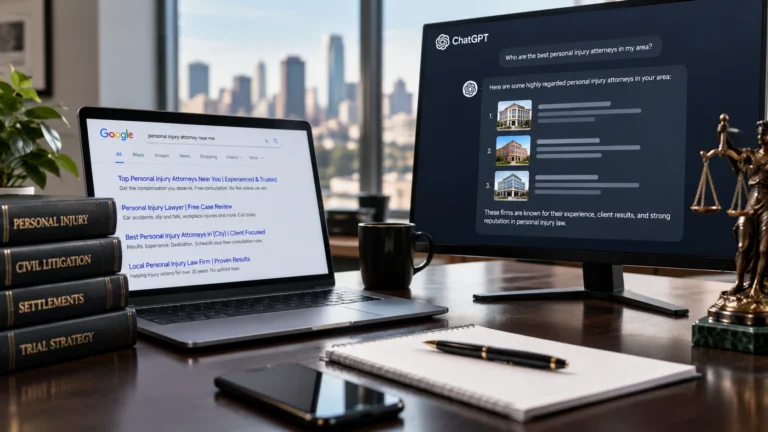
You’re spending serious money on PPC. Your firm ranks well in Google. And when a prospective client asks ChatGPT or Google AI Overview to recommend a personal injury attorney in your city, your name doesn’t come up. That’s not a ranking problem. It’s a structural visibility problem, and schema markup combined with coordinated authority citations is what solves it.
Key Takeaways
- Structured data schema is the machine-readable layer that tells AI systems precisely who your firm is, what you do, and where you practice.
- Authority citations across independent platforms either confirm or contradict your schema claims; consistency is what builds AI confidence.
- AI systems identify entities they can verify. They skip entities they can’t, regardless of traditional search rankings.
- Most PI firms have AEO Blockers, structural problems invisible in standard SEO reporting, that prevent AI systems from recognizing their authority.
- The window to establish AI recommendation authority ahead of your competitors is open now, not permanently.
Why Does Ranking Well in Google No Longer Guarantee AI Visibility?
Traditional search and AI-driven search use fundamentally different logic. Google evaluates pages based on relevance signals, links, and engagement. AI systems like ChatGPT, Perplexity, and Google AI Overview do something different: they identify entities they can confirm as authoritative and synthesize answers from those sources.
The mechanism is different at the root level. A page can rank first in Google and still be completely absent from AI-generated answers, because the AI never confirmed what the firm actually is. It can’t match your self-declared identity against external corroboration. So it doesn’t mention you.
You’re not being penalized. You’re being skipped entirely.
That distinction matters strategically. It means a firm can sustain strong PPC performance, solid rankings, and consistent traffic while quietly losing ground in the layer where AI-driven prospects are forming their opinions before they ever click anything. The shift from traditional SEO to AI search is already reshaping how personal injury clients find and evaluate firms.
What Is Structured Data Schema and Why Does It Matter for AI Visibility?
Structured data schema is a standardized code vocabulary maintained at Schema.org. It lets you annotate your website so machines can read its contents precisely, rather than guessing.
Without schema, an AI model reading your firm’s website has to infer what you do, who your attorneys are, where you practice, and what your credentials mean. It’s working from implication. With schema, you’re providing direct instructions: this is a LegalService entity, this is the attorney’s name and bar credentials, this is the geographic service area, these are the practice areas.
That matters because AI systems aren’t browsing pages the way humans do. They’re constructing a model of your entity by cross-referencing structured signals. Schema is the vocabulary they read most reliably. Without it, even a well-written, well-linked website is harder for an AI system to interpret with confidence.
Schema markup doesn’t directly cause AI recommendations. What it does is remove the ambiguity that would otherwise prevent a recommendation. It’s the first step in a chain: your firm declares its identity clearly, and then external sources either confirm or contradict that declaration.
What Are Authority Citations and How Do They Work With Schema?
Authority citations are structured mentions of your firm’s identity across trusted external platforms. Legal directories, local business listings, news outlets, social profiles, and industry publications. The signals include your firm name, address, phone number, practice areas, and attorney credentials.
The relationship between schema and citations isn’t additive. It’s confirmatory.
Here’s the causal chain: your schema markup makes a claim about who your firm is. Authority citations across independent platforms either verify or undermine that claim. When an AI system evaluates whether to recommend your firm, it’s cross-referencing your self-declared identity against what external sources say about you. Consistent signals across a large number of platforms tell the AI that your entity is real, established, and trustworthy.
Consider a scenario where a PI firm in a competitive metro has technically correct schema on their website, but their citation profile is a mess. The firm name appears three different ways across directories. Phone numbers don’t match between Avvo, their Google Business Profile, and their own site. Practice areas are listed inconsistently depending on the platform. An AI system trying to verify this entity often hits contradictions at every turn. AI systems typically don’t recommend entities they can’t confidently verify. That kind of inconsistency is an AEO Blocker: invisible in standard SEO reporting, actively suppressing AI visibility.
Elite AEO Labs’s Core plan includes 500+ authority citations built across multiple platforms to eliminate exactly these contradictions and strengthen entity recognition. The Authority plan scales to 1,000+ citations with national media distribution to 300+ trusted news and social platforms, which is typically the level firms competing in high-density metros require. Understanding what AEO optimization actually does for a business helps clarify how citation building fits into the broader AI visibility picture.
The Schema-Citation Stack: A Diagnostic Framework for PI Firms
Think of AI recommendation authority as three layers. Each one depends on the one below it.
Layer 1: Entity Declaration (Schema Markup)
Your website declares who you are. LegalService schema, Attorney schema, LocalBusiness schema with accurate name, address, and phone, practice area markup, and geographic service area. If this layer is incomplete or incorrect, everything above it is weakened because the AI’s model of your entity starts from a flawed foundation.
Layer 2: Entity Confirmation (Authority Citations)
External platforms confirm your declared identity. Legal directories, business listings, news mentions, social profiles. The more platforms that confirm your entity consistently, the stronger the AI’s confidence becomes. This is where most PI firms have unaddressed gaps.
Layer 3: Entity Authority (Content and Media Signals)
AI-optimized content and media distribution signal that your firm isn’t just real but authoritative on the topics relevant to your practice. This layer is where AI systems start treating you as a source worth citing rather than just an entity worth acknowledging.
A firm that has Layer 1 but not Layer 2 is making claims with no corroboration. The AI registers the claim. I can’t confirm it. The recommendation doesn’t happen.
This framework is useful when you’re trying to diagnose why your firm isn’t appearing in AI answers despite strong traditional SEO performance. It’s less immediately useful if your website has unresolved technical crawlability issues, because schema signals that never reach an AI system can’t do anything. Those foundational problems have to come first.
Comparing Approaches: Acting Now vs. Waiting
| Scenario | What Happens to Your AI Visibility |
|---|---|
| Schema and citation strategy implemented now | AI systems can verify your entity, consistency is established, firm becomes a candidate for recommendations in your metro |
| Waiting for traditional SEO to handle it | AI systems use different evaluation logic; strong rankings don’t transfer to AI recommendations; gap widens as competitors act |
| Attempting citation building without coordinated schema | Citations confirm a poorly defined entity; contradictions persist; AI confidence stays low |
| No action taken | Competitors who establish entity authority early become significantly harder to displace; cost per signed case continues climbing without addressing the upstream shift |
The firms that build entity authority now are establishing a position that becomes harder to displace as AI search continues to mature. How AI search engines recommend businesses explains the selection logic behind that dynamic.
What Realistic Outcomes Look Like
A PI firm that completes a full schema and citation implementation can expect AI systems to be able to confirm its entity, citations to be consistent across platforms, and the firm to become a genuine candidate for AI recommendations in its market. That’s the structural shift that makes AI visibility possible.
What that doesn’t mean: you don’t flip a switch and dominate AI results the following week. Citation building is cumulative. AI systems update their entity models over time as more platforms confirm your identity consistently. For most firms, meaningful improvement in AI visibility develops over several months of consistent implementation. Firms with significant existing citation inconsistencies, or those competing in the densest metros, may take longer. Any provider claiming otherwise isn’t being straight with you.
Nestlé found that pages appearing as rich results in Google had an 82% higher click-through rate than non-rich result pages, according to Google Search Central case study documentation. That’s a traditional search outcome. The AI visibility impact is less about click-through rates and more about whether your firm gets mentioned at all when a prospect asks an AI assistant for a recommendation.
If your firm is in an expansion phase, adding attorneys or intake staff, this is the right moment to build AI authority infrastructure. You’re already investing in capacity. The acquisition signals should match that investment. You can review how Elite AEO Labs’s AEO optimization methodology actually works before making any decision.
Who This Is Built For
Straight talk on fit: this approach delivers the clearest ROI for growth-aggressive PI firms already spending seriously on acquisition, watching their cost per signed case climb, and operating in markets where AI-driven discovery is already shifting how prospective clients form opinions.
If your firm has fewer than 10 attorneys and is spending under $10,000 a month on acquisition, the infrastructure investment may not yet match your intake capacity. The math works when you can convert the additional visibility into signed cases at scale.
If your website has unresolved technical issues preventing crawling or indexing, schema markup won’t help until those are addressed. You’d be annotating pages AI systems can’t read.
The timing of when to act on AEO blockers matters. Acting before your competitors establish authority is the position. Acting after is recovery.
Frequently Asked Questions
How is structured data schema different from regular SEO metadata?
SEO metadata like title tags and meta descriptions is written for human readers and traditional search engine interpretation. Structured data schema is written in a machine-readable vocabulary that specifies what type of entity a page represents, what its attributes are, and how it relates to other entities. The two systems serve different evaluation logic.
Does my firm need schema markup if we already rank well in Google?
Strong Google rankings don’t transfer to AI visibility because the evaluation systems use different signals. Google ranks pages based on relevance and link authority. AI systems verify entities based on structured signals and cross-platform confirmation. A firm can rank well in traditional search and still be absent from AI-generated answers.
How long does it take for authority citations to improve AI visibility?
Citation building is cumulative. AI systems update their entity confidence over time as more external platforms confirm your firm’s identity consistently. Most firms see meaningful improvement in AI visibility over several months of consistent work. Firms with significant existing citation inconsistencies or those in high-density competitive markets may take longer. There’s no shortcut that changes this timeline.
What’s an AEO Blocker and how do I know if my firm has one?
An AEO Blocker is any structural issue that prevents AI systems from correctly identifying, verifying, or citing your firm. Common examples include inconsistent name, address, and phone data across platforms, missing or incorrect schema markup, thin entity signals, and contradictory practice area descriptions. Most PI firms have multiple AEO Blockers they’re unaware of because these issues don’t appear in standard SEO reporting. Elite AEO Labs’s AEO Blocker Audit is built specifically to surface them.
Can’t we just add schema markup ourselves?
Basic schema can be added without outside help. What’s harder to replicate independently is coordinated citation building across 500 to 1,000+ platforms, the AI-optimized content layer, and ongoing monitoring as AI systems continue evolving their evaluation criteria. The schema is the starting point. The citation network is what confirms your entity at the scale AI systems need to establish recommendation confidence.
What’s the difference between the Core and Authority plans?
The Core plan is $1,500 per month plus a one-time $1,000 setup fee. It includes 500+ authority citations and up to two AI-optimized content pieces per month, suited for firms in moderate competitive markets. The Authority plan is $2,500 per month plus the same one-time setup fee. It includes 1,000+ citations, up to four content pieces per month, and national authority media distribution to 300+ trusted news and social platforms. High-competition metros typically require the Authority plan to build the citation volume needed to stand out. Both plans operate month-to-month and can be canceled with 30 days written notice.
Will this replace our PPC and LSA spend?
No. AEO and paid acquisition serve different parts of the client acquisition process. Paid ads capture intent at the moment of search. AI visibility shapes the evaluation that happens before the search, when prospective clients are asking AI assistants to help them understand their options. The firms that win in competitive markets will be strong in both layers. If your paid spend keeps climbing without margin improvement, the issue is often in your entity signals upstream, not in your ad creative. See what’s blocking your firm’s AI visibility before another quarter passes.
Brett Franks is the Co-Founder and Lead Strategist at Elite AEO Labs. He specializes in Answer Engine Optimization and Generative Engine Optimization, helping businesses transition from traditional SEO to AI-driven authority by building machine-readable entity signals that get them recommended by AI systems including ChatGPT, Perplexity, and Google AI Overview. Elite AEO Labs works with growth-oriented businesses across the United States to identify AEO Blockers and build the technical and authority infrastructure required for AI recommendation visibility.