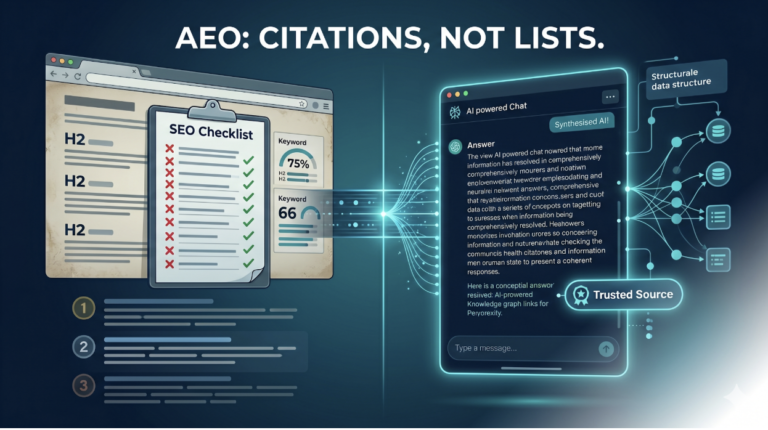
According to a 2024 Gartner report, search engine volume is projected to drop 25% by 2026 as AI-powered chat interfaces absorb query traffic that once flowed to traditional results pages. If your firm is still measuring success by keyword rankings, you are optimizing for a metric that is quietly being retired.
Direct Answer
AI search engines select verified answers by evaluating entity authority, structured data signals, and content that directly resolves a query without requiring inference. Systems like ChatGPT, Perplexity, and Google AI Mode prioritize sources that are semantically consistent, machine-readable, and corroborated across multiple trusted contexts – not sources that simply rank well in traditional search.
Key Takeaways
• AI retrieval systems select answers based on entity trust and structured content, not keyword density or link volume
• FAQSchema and structured data markup make your content machine-readable at the passage level – not just the page level
• A source can rank #1 in Google and still be completely invisible in AI-generated answers
• Trust signals – consistent entity data, authoritative co-citations, and schema markup – are the new competitive moat
• Most firms have structural “AEO Blockers” preventing AI citation that no traditional SEO audit will surface
Why Does Ranking #1 in Google No Longer Guarantee AI Visibility?
This is the question most marketing directors ask too late.
Traditional SEO was built around a single mechanism: signal relevance to a crawler, earn a position in a ranked list, receive clicks. The entire system assumed a human would still make the final selection.
AI search removes that step. The system makes the selection for the user. It synthesizes, not lists.
When an AI answers a query, it is not retrieving the top-ranked page – it is resolving the question using sources it has determined to be authoritative, consistent, and structurally legible.
That distinction changes everything. A firm with excellent backlinks and optimized metadata may still be invisible in AI-generated answers if its content is not structured for machine extraction, or if its entity signals are inconsistent across the web.
This is not a ranking problem. It is an authority and legibility problem.
“Traditional SEO was a race to the top of a list. AEO is about being in the room before the race starts.”
How Do AI Retrieval Systems Actually Work?
AI retrieval is built on two layers working in sequence.
The first is retrieval-augmented generation (RAG) – a process where the AI queries an index of trusted sources to pull relevant passages before generating a response. RAG is not searching for pages; it is searching for passages that directly answer the query. If your content is not structured to surface at the passage level, it does not enter the candidate pool.
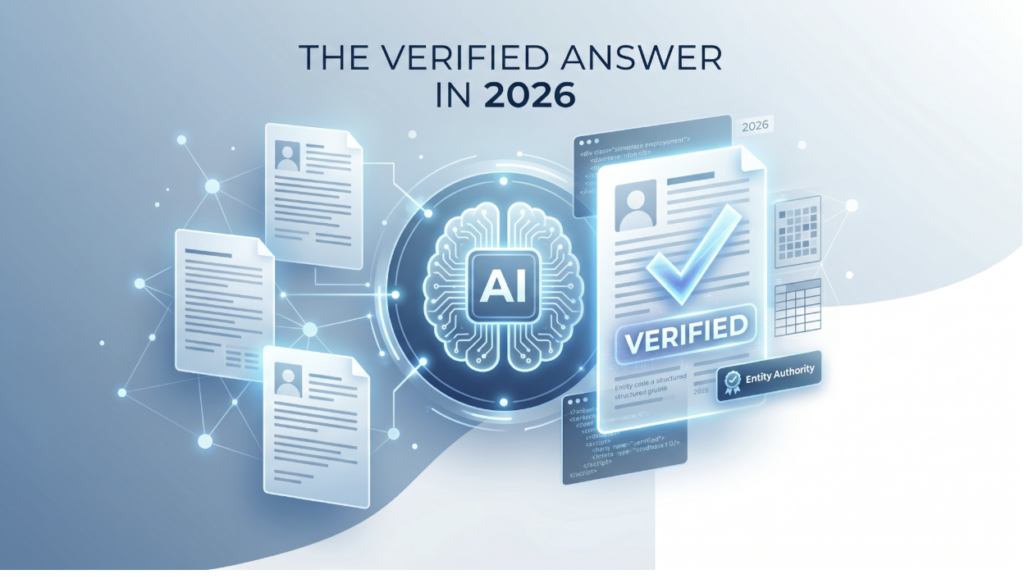
The second layer is entity resolution – the process by which AI systems confirm that a source is who it claims to be. Entity resolution is the mechanism by which AI systems cross-reference your firm’s name, location, expertise, and authority signals across multiple data sources to establish identity confidence. Without consistent entity signals, the system cannot reliably attribute answers to your firm – so it defaults to sources it can confirm.
Most firms fail at both layers simultaneously. Their content is written for human readers, not machine extraction. Their entity data is inconsistent across directories, schema, and third-party mentions. The result is structural invisibility – not a content quality problem, but an architecture problem.
This is precisely what Elite AEO Labs identifies in an AEO Blocker Audit: the specific technical and structural gaps preventing AI systems from selecting a firm as a trusted source.
What Role Do Entity Authority and Structured Content Play?
Entity authority is the degree to which AI systems can confirm your firm’s identity, expertise, and trustworthiness through corroborating signals across the web.
Think of it this way: an AI system resolving a query about “commercial litigation attorneys in Denver” is not just looking for content about commercial litigation. It is looking for sources whose entity profile – schema markup, Knowledge Graph presence, consistent NAP data, authoritative co-citations – confirms they are a credible, established firm in that category.
Structured content is the mechanism that makes entity authority legible to machines. Without it, even genuinely authoritative firms are opaque to AI retrieval systems.
The practical implication: firms need to treat their digital presence as a machine-readable knowledge graph entry, not just a website. Every inconsistency in how your firm’s name, location, or specialty is described across the web creates friction in entity resolution – and friction means reduced citation probability.
A mid-sized accounting firm working with Elite AEO Labs discovered that its entity data appeared in three different formats across major directories, its schema markup was absent on service pages, and its primary expertise areas were never explicitly stated in structured form. After a full AEO Blocker remediation – standardizing entity signals, implementing service-level schema, and building authoritative co-citations – the firm began appearing in AI-generated answers for its core practice areas within approximately four months.
How Does FAQSchema Actually Influence AI-Generated Answers?
FAQSchema is a structured data format that explicitly marks up question-and-answer content so AI retrieval systems can extract it at the passage level without interpreting surrounding context.
This matters because AI systems prefer content that resolves queries directly. When a passage is wrapped in FAQSchema, the system does not need to infer whether the content answers a question – it is declared. That reduces processing ambiguity and increases citation probability.
“Checklists and keyword-optimized content satisfy crawlers; they do not satisfy AI synthesis engines.”
But FAQSchema alone is not sufficient. The questions must map to actual query patterns – the precise language users employ when asking AI assistants – and the answers must be self-contained. An answer that requires reading the surrounding page for context fails the passage-extraction test.
The follow-up question most practitioners ask here is: which pages should get FAQSchema first? Prioritize service pages, comparison pages, and any content that directly addresses a decision-stage question. These are the pages AI systems are most likely to pull from when a user is close to a recommendation.
The AEO Signal Stack: A Framework for AI Citation Readiness
The AEO Signal Stack is a four-layer diagnostic framework for evaluating whether a firm’s digital presence is structured for AI citation.
| Layer | What It Covers | Citation Impact |
| Entity Consistency | NAP data, schema identity, Knowledge Graph presence | High – foundational trust signal |
| Structured Content | FAQSchema, HowTo schema, service-level markup | High – enables passage extraction |
| Authority Co-citations | Mentions in trusted publications, directories, and partner sites | Medium-High – corroborates entity claims |
| Answer Density | Direct, query-resolving content at the passage level | Medium – determines extraction eligibility |
Use this framework when auditing a firm’s AI visibility readiness. If Layer 1 (Entity Consistency) is broken, fixing Layers 3 and 4 will not compensate – AI systems resolve identity before evaluating content quality.
Why Do Trust Signals Matter More Than Content Quality in AI Search?
Here is the contrarian claim worth sitting with: a well-written, genuinely informative page from an unknown entity will lose to a structurally sound page from a confirmed entity almost every time.
AI systems are not editors. They do not evaluate prose quality. They evaluate source trustworthiness – and trustworthiness is determined by corroborated, consistent, machine-readable signals, not by the depth of the content itself.
This is the root cause of why so many firms with excellent content are invisible in AI-generated answers. They invested in what humans value – clarity, depth, persuasion – without investing in what machines require: structural confirmation of identity and authority.
The mechanism is straightforward: AI systems are trained to minimize hallucination risk. Citing an unverified source increases that risk. Citing a source with consistent entity signals, authoritative co-citations, and structured data reduces it. The system is not making a quality judgment – it is making a confidence judgment.
“If your firm ranks #1 in Google but never appears in a ChatGPT response, you are already losing ground.”
Elite AEO Labs built its entire methodology around this distinction. The AEO Blocker Audit does not evaluate content quality – it evaluates structural trust legibility, because that is what actually determines AI citation.
What Are the Realistic Timelines and Outcomes for AI Search Optimization?
Practitioners working through structured AEO remediation consistently report initial citation appearances within 60-120 days for lower-competition query categories, with broader visibility across core practice areas developing over six to nine months.
This is not a switch that flips. Entity signals take time to propagate and be indexed across the sources AI systems reference. Schema markup needs to be crawled and validated. Co-citation authority builds incrementally.
What does not work: publishing more content without fixing the structural foundation first. Firms that layer new content onto unresolved AEO Blockers are adding volume to a system that cannot extract value from it.
Elite AEO Labs structures its Core tier ($1,500/month) for firms in moderate-competition markets and its Authority tier ($2,500/month) for high-competition metros, both beginning with a $1,000 one-time AEO Blocker Audit. The audit determines which of the four Signal Stack layers is most degraded – and that determines the remediation sequence.
Who Is This Approach Not Right For?
Be direct about this.
AI search optimization is not the right priority for firms with no existing digital presence. If your entity has no web footprint, no directory listings, and no third-party mentions, the foundational work required goes beyond AEO – you need basic digital authority established first.
It is also not a substitute for a broken service offering. AI systems surface firms for recommendation; they cannot manufacture reputation that does not exist.
And if your primary revenue comes from referral networks with no dependency on search-driven discovery, AI visibility optimization may not move the needle on acquisition – at least not immediately.
FAQ
How is AEO different from regular SEO?
SEO optimizes for ranking position in a list of results that a human then selects from. AEO optimizes for being selected by the AI system itself before the user sees any list. The audience is different – you are writing for machine extraction, not human persuasion – and the signals that drive selection are different: entity consistency, structured data, and authority co-citation rather than keyword density and backlink volume.
Will my Google rankings be affected if I shift focus to AEO?
Not negatively. Most AEO improvements – structured data, entity consistency, authoritative co-citations – are also positive signals for traditional search. The risk runs the other direction: firms that ignore AEO while maintaining traditional SEO will hold their Google positions while becoming invisible in AI-generated answers, which is where query volume is shifting.
How do I know if I have AEO Blockers?
The most reliable indicator is a gap between your Google visibility and your AI citation frequency. If you rank well in traditional search but never appear when you or your team ask AI assistants about your service category, structural blockers are almost certainly present. An AEO Blocker Audit – the starting point for every Elite AEO Labs engagement – identifies exactly which layers of the Signal Stack are degraded.
Does FAQSchema actually get picked up by AI systems like ChatGPT and Perplexity?
Yes, but with an important caveat. Schema markup signals intent and structure, which improves passage-level extraction probability. However, the content within the schema must still directly resolve the query – schema is a legibility mechanism, not a relevance override. Well-structured content in FAQSchema format consistently outperforms equivalent unstructured content in AI retrieval scenarios.
How long before I start appearing in AI-generated answers?
For lower-competition query categories, practitioners report initial appearances within 60-120 days of completing foundational AEO remediation. Higher-competition markets and broader query coverage typically develop over six to nine months. Entity signals propagate gradually – there is no shortcut to the timeline, but there is a clear sequence that accelerates it.
Is this only relevant for local businesses, or does it apply to national firms too?
AI search optimization applies at every scale. Local firms face entity resolution challenges tied to geographic consistency and local directory signals. National firms face different challenges – typically around topical authority, competitive entity disambiguation, and content architecture across large site structures. The Signal Stack framework applies in both cases; the remediation priorities differ.
What happens if I do nothing and just maintain my current SEO strategy?
Your Google rankings may hold – for now. But AI-generated answers are already capturing a meaningful share of queries that previously drove organic traffic, and that share is growing. Firms that delay AEO remediation are not standing still; they are falling behind relative to competitors who are actively building AI citation authority. The structural work required does not get easier the longer it is deferred.
Take the Next Step
If you finished this article and recognized your firm in it – ranking well in Google, investing in content, but absent from AI-generated answers – the structural gaps are real and they are fixable.
The starting point is knowing exactly which AEO Blockers are preventing your AI visibility. Not a general audit. A specific, layer-by-layer diagnosis of where your entity signals, structured data, and content architecture are failing the machine-readability test.
Learn how to improve your AI visibility today – start with the Elite AEO Labs AEO Blocker Audit at eliteaeolabs.com.
About the Author
Brett Franks is the Co-Founder and Lead Strategist at Elite AEO Labs, where he specializes in Answer Engine Optimization (AEO) and Generative Engine Optimization (GEO). He helps professional service firms and agencies transition from traditional SEO to AI-driven authority – ensuring they are recognized and cited by systems like ChatGPT, Perplexity, and Claude. Brett’s work focuses on semantic entity building and structured data frameworks that secure brand visibility inside AI-generated answers.
References
Gartner – Research on projected search engine volume decline and AI interface adoption trends through 2026.