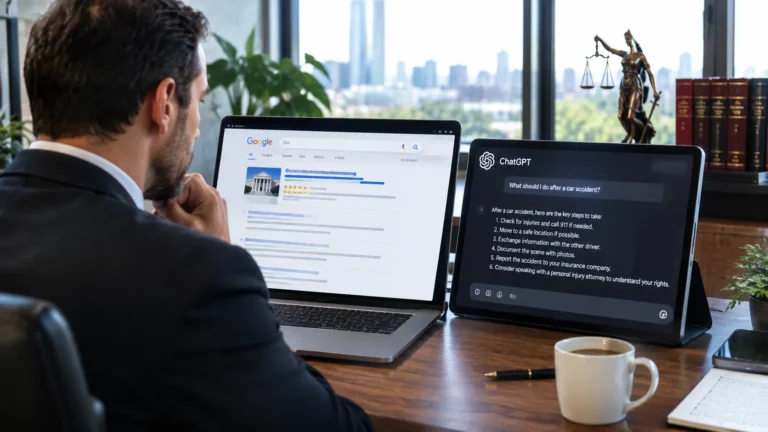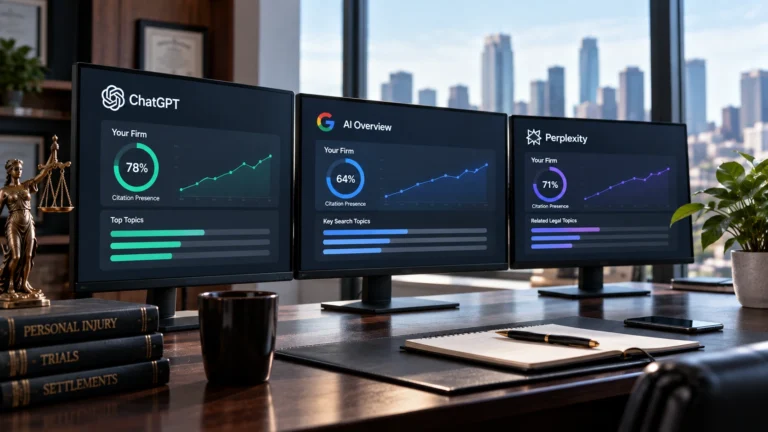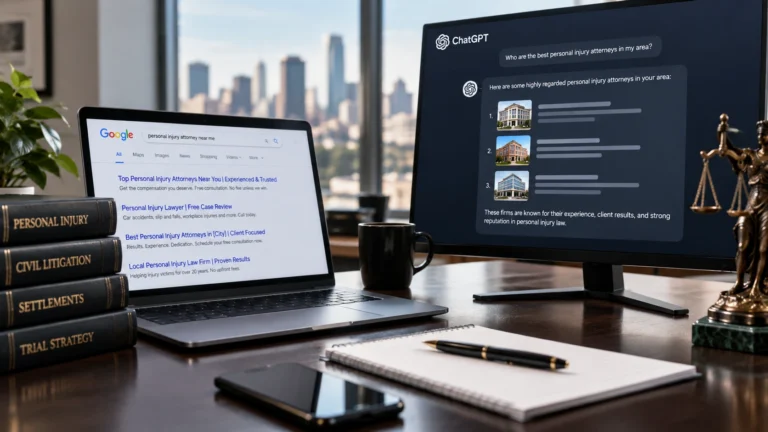
SEO earns rankings in traditional search. AEO earns recommendations in AI-generated answers. Those are different systems with different signals and different stakes. For PI firms competing in high-volume metros, the distinction is becoming a direct factor in how many qualified prospects ever encounter your firm’s name.
Key Takeaways
- A firm can rank #1 in Google and be completely invisible in ChatGPT, Perplexity, or Google AI Overview.
- AI systems don’t reward keyword density. They reward entity clarity, structured data, and verifiable authority signals.
- AEO Blockers are structural issues that prevent AI systems from understanding or citing your firm, even when your SEO is strong.
- PI firms spending heavily on paid acquisition face compounding exposure: high spend against a shrinking AI-driven discovery surface means each signed case costs more over time.
- The firms building AI recommendation authority now will be significantly harder to displace once that layer consolidates around early movers.
What’s the Real Difference Between AEO and SEO?
Search engine optimization earns you a ranking. Answer engine optimization earns you a citation in the answer itself.
In traditional search, a prospect types “car accident lawyer in Dallas,” gets a list of results, and clicks. Your website is where the decision plays out. In AI-driven search, that same prospect asks Google AI Overview or ChatGPT the same question and receives a synthesized response that names two or three firms directly. The recommendation has already been made before a single click occurs.
SEO was designed for a world where people browse results. AEO is designed for a world where AI systems make the introduction on your behalf.
For personal injury firms, the practical implication is sharp. PI clients are frequently in distress, making fast decisions, and turning to AI assistants for the kind of guidance they’d previously get from a friend or a quick Google search. The firm that appears in that answer owns the moment. The firm that doesn’t isn’t losing a click. It’s being removed from the consideration set entirely.
Why Doesn’t Strong SEO Automatically Transfer to AI Visibility?
This is the piece that catches most PI firm owners off guard, and it’s worth explaining precisely.
Google’s traditional algorithm rewards backlinks, keyword relevance, on-page optimization, and page experience metrics. AI systems like ChatGPT and Perplexity are built differently. They’re trained to synthesize answers from sources they’ve assessed as structured, semantically clear, and credible on a given topic. The signals they rely on are different: entity clarity, schema markup, consistent structured data, and authority confirmation across the knowledge graph.
A firm with a heavily optimized site for traditional search can score well on every conventional SEO metric while having multiple AEO Blockers that make it invisible to AI. Missing or broken schema, inconsistent entity data across directories, a Google Business Profile disconnected from a coherent entity definition, content written for keyword clustering rather than direct-answer extractability. The AI system encounters a structurally ambiguous source and skips it. Not because the firm lacks reputation. Because the signals the AI needs to cite it with confidence aren’t there.
This is the core diagnosis work behind the AEO Blocker Audit that Elite AEO Labs runs at the start of every engagement. Without identifying the specific structural issues, any optimization effort is guesswork.
How Do AI Systems Actually Decide Which Firms to Recommend?
AI systems don’t rank pages. They synthesize answers from sources they’ve determined are credible, clear, and authoritative on a specific topic in a specific geography.
When a user asks an AI assistant about personal injury attorneys in their city, the model pulls from sources it can cite confidently without risk of producing a wrong or misleading answer. It’s not pulling the top Google result. It’s pulling the source it can most accurately represent.
That mechanism means three things have to work together for AI visibility:
Entity clarity: the AI needs to understand, without ambiguity, who your firm is, what practice areas you hold, and where you serve clients. Inconsistent information across your site, directories, and profiles creates ambiguity. Ambiguous sources don’t get cited.
Structured data: schema markup tells AI systems what your content means, not just what it says. A page that describes your practice areas in conversational prose is less useful to an AI than a page with the same information structured so the model can extract it reliably.
Authority signals: citations, directory consistency, and media presence that confirm your firm is a recognized, verifiable entity in your field. AI systems weight confidence in a source partly through how consistently that entity is recognized elsewhere.
Consider a typical scenario: a mid-sized PI firm in a competitive metro has invested substantially in traditional SEO. Their rankings are strong. But if their schema is incomplete, their entity data is inconsistent across directories, and their content is optimized for keyword density rather than AI extractability, a smaller competitor with cleaner entity signals is likely the one appearing when a prospective client asks for a recommendation. This is the pattern that an AI search optimization strategy is designed to reverse.
The Two-Layer Acquisition Model: Where SEO Ends and AEO Begins
It helps to think about your firm’s discovery environment as two separate layers that require different approaches.
Layer 1 is traditional search: keyword rankings, click-through rates, paid search performance, page-level authority. SEO is built for this layer.
Layer 2 is AI recommendation: entity recognition by AI systems, citations in AI-generated answers, structured data completeness, authority signal density. This layer didn’t exist at a meaningful scale until recently. SEO was never designed to address it.
The table below maps common PI firm situations to where each approach helps and where it falls short.
| Situation | SEO Alone | Acting Now with Elite AEO Labs |
|---|---|---|
| Competitor appearing in AI Overview for your terms | Doesn’t address it | Directly targets the underlying visibility gap |
| Rising cost per signed case despite stable rankings | Doesn’t explain or fix it | Addresses the AI-layer attrition driving acquisition costs up |
| Expanding to new markets or adding practice areas | Partial coverage | Establishes AI authority in new markets before competitors do |
| Heavy paid spend without margin improvement | Doesn’t reduce dependence on paid channels | Builds organic AI recommendation that operates alongside paid |
| Stable rankings, stable leads, no visible AI competitor threat | Maintains current position | Protects against future displacement while the window is still open |
Inaction feels safe until the competitor who moved six months earlier is already the firm ChatGPT name. At that point, displacement is genuinely harder. AI systems build confidence in a source over time, and a firm already established as a trusted recommendation has a structural head start that takes real effort to overcome.
What Does an AEO Program Actually Look Like?
Understanding the mechanics matters because it clarifies what you’re actually buying.
Elite AEO Labs operates a four-stage methodology. The engagement starts with the AEO Blocker Audit, which identifies the specific structural issues preventing AI systems from reading and citing your site. The audit isn’t a generic checklist. It maps your firm’s actual blockers: the schema gaps, the entity inconsistencies, the content problems that make your site machine-unreadable at the level AI systems require.
From there, authority signals and content are optimized for AI extractability. This is different from optimizing for keyword relevance. The goal is content that an AI model can parse, extract, and cite with precision.
Technical implementation follows: schema markup, structured data, and entity signal alignment that makes your firm clearly recognizable to AI systems across the knowledge graph.
The fourth stage is ongoing monitoring and refinement. AI platforms update their training signals continuously. A one-time optimization doesn’t hold indefinitely. Staying ahead of those shifts is an ongoing operational function, not a one-time project.
The Core plan is $1,500 per month, with a $1,000 one-time setup fee, and includes 500+ authority citations and up to two AI-optimized content pieces per month. The Authority plan is $2,500 per month with the same setup fee, and includes 1,000+ authority citations, up to four AI-optimized content pieces per month, and national authority media distribution to 300+ trusted news and social media platforms. Both plans are billed monthly and can be canceled with 30 days written notice.
For PI firms in high-competition metros, the Authority plan is typically the appropriate starting point. The citation volume and media distribution are what build the authority signal density AI systems need to recommend your firm with confidence over a competitor with similar credentials. You can get a clearer picture of what ranking in AI search results requires to understand where the technical build fits in.
Where This Approach Has Real Limits
Straight talk matters here. AI visibility builds over months, not weeks. The AEO Blocker Audit and technical implementation happen first, but authority signal accumulation and entity recognition by AI systems takes time to compound. A firm starting this month isn’t going to dominate AI recommendations by next month.
What AEO also doesn’t do is fix a broken intake process. If your firm can’t convert inquiries efficiently, increased visibility creates more pressure on a system that’s already struggling. The visibility improvement is real; what happens after the call remains your operation to manage.
This program fits firms operating in competitive metros with the intake capacity to handle more volume and the acquisition spend to make the comparison meaningful. It’s not the right starting point for firms that are just getting their digital presence established. The timing of AEO adoption is worth thinking through carefully, because early movers and late adopters face genuinely different situations.
If you want to know where your firm specifically stands, the AEO Blocker Audit is where that conversation starts.
Frequently Asked Questions
If my firm already ranks on page one of Google, why would I be invisible in AI search?
Google’s traditional ranking algorithm and AI recommendation systems rely on different signals. Google rewards backlinks, keyword relevance, and page experience. AI systems favor structured, semantically clear sources with explicit entity signals and schema markup. A site built entirely for traditional search can have multiple AEO Blockers that make it unreadable to AI systems regardless of where it ranks. Strong Google rankings don’t transfer automatically.
How long does it take to see results from AEO?
AI visibility compounds over months. The Blocker Audit and technical implementation happen in the early stage, but authority signal accumulation and entity recognition by AI systems takes sustained effort. Firms that build now develop an advantage that gets harder for competitors to close over time. Firms that wait are starting from a deficit against competitors who’ve already established that authority.
Is AEO just SEO with a different name?
No. The two approaches target different systems, use different signals, and serve different goals. SEO earns rankings in traditional search. AEO earns citations in AI-generated answers. The overlap is minimal: a well-optimized SEO site and a well-optimized AEO presence require different technical implementations, different content structures, and different authority-building strategies. You can review how AI-driven SEO differs from traditional approaches for a direct breakdown.
What’s an AEO Blocker, and how do I know if my firm has one?
An AEO Blocker is any structural, technical, or content-level issue that prevents AI systems from correctly interpreting or citing your site. Common examples include missing or misconfigured schema markup, inconsistent entity data across directories, and content structured around keyword density rather than AI extractability. The only reliable way to identify your firm’s specific blockers is through an AEO Blocker Audit. Without that diagnosis, you’re guessing which problems exist and in what order they need to be addressed.
Does AEO replace our PPC or LSA spend?
Not immediately. AEO builds an organic AI recommendation layer that reduces dependence on paid acquisition over time, but it doesn’t replace paid channels in the short term. The strategic case is that firms spending heavily on paid acquisition while their AI visibility is weak are paying more per signed case for a shrinking share of the discovery surface. AEO addresses the part of the discovery process that paid ads can’t reach at all. You can see how the future of AI search affects acquisition planning for more context on how the two approaches fit together.
Why does the timing of AEO adoption matter?
AI-driven search platforms have moved from novelty to primary research tool for a significant share of the population. Prospective PI clients are asking ChatGPT and Google AI Overview for attorney recommendations before they visit a single website. The firms that establish AI recommendation authority during this window will be significantly harder to displace once the market consolidates around early movers. The window is open. It won’t stay open.
What’s the difference between the Core and Authority plans?
The Core plan at $1,500 per month is designed for moderate-competition markets. It includes 500+ authority citations, up to two AI-optimized content pieces per month, and a $1,000 one-time setup fee. The Authority plan at $2,500 per month is built for high-competition metros. It includes 1,000+ authority citations, up to four content pieces per month, national authority media distribution to 300+ trusted news and social media platforms, and the same setup fee. Both plans can be canceled with 30 days written notice. For most PI firms in major metros, the Authority plan is where the authority signal density required for competitive AI visibility actually begins.
About the Author
Brett Franks is the Co-Founder and Lead Strategist at Elite AEO Labs. He specializes in Answer Engine Optimization and Generative Engine Optimization, helping businesses build the entity signals and structured authority that AI systems require to recommend them over competitors. His work focuses on making brands machine-readable and citation-worthy across AI platforms including ChatGPT, Perplexity, and Claude.