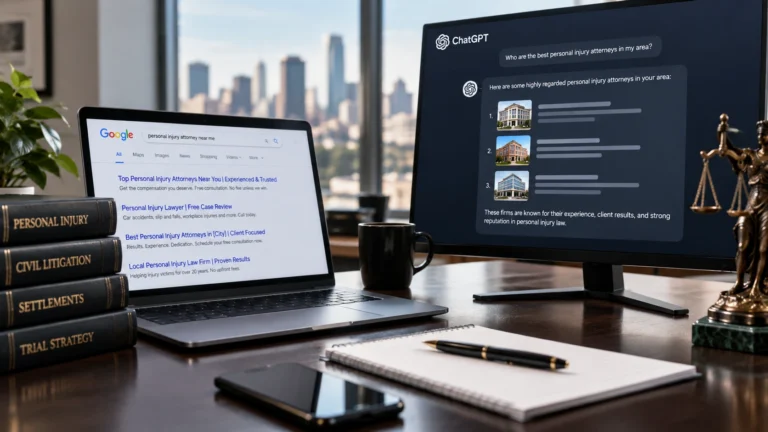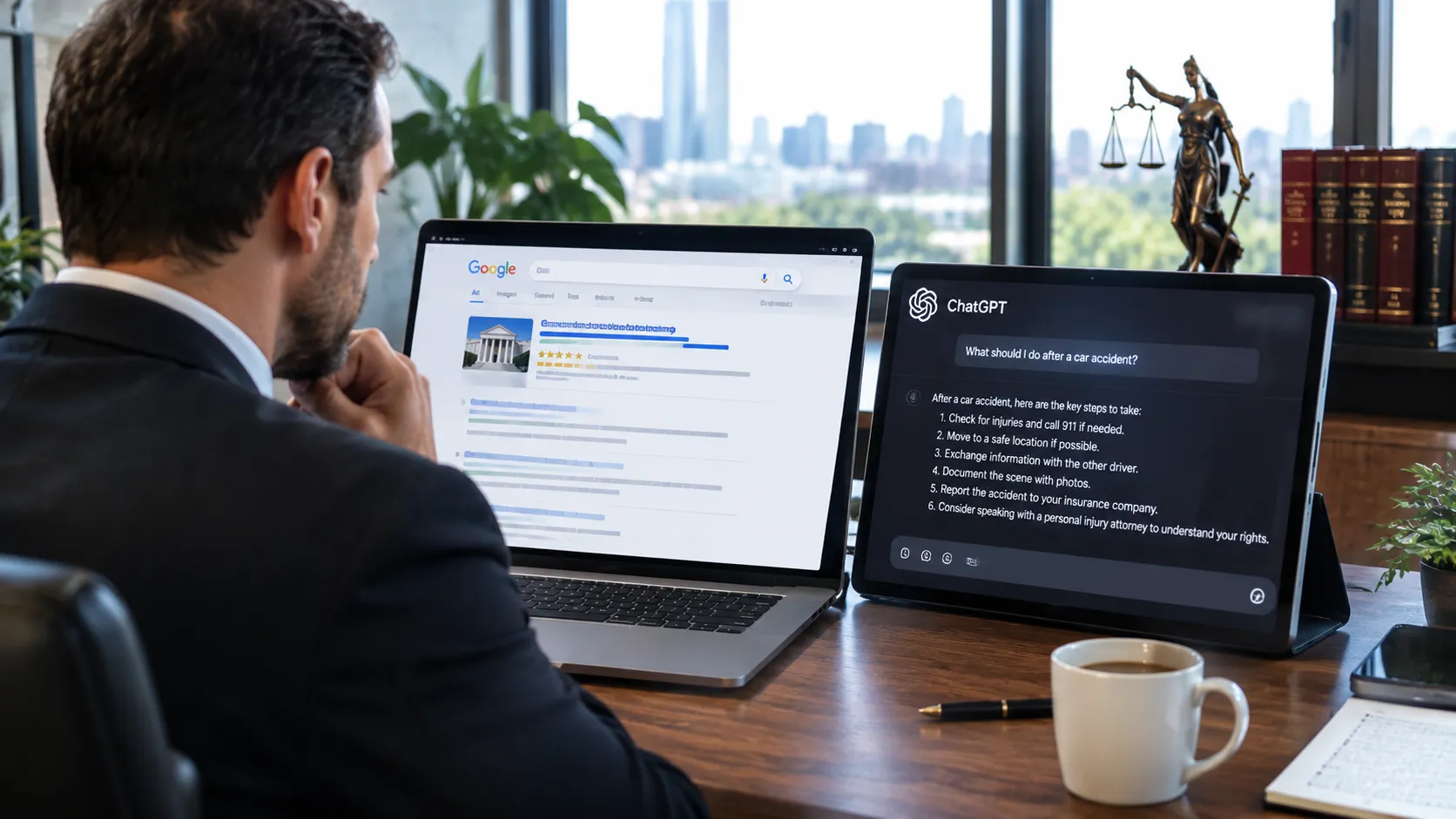
Google rankings and AI-generated answers operate on completely separate selection logic. A personal injury firm can hold the top organic spot in its market and still be absent from ChatGPT, Perplexity, and Google AI Overview, because those systems evaluate entity clarity, structured data quality, and cross-source authority signals on their own terms. A dominant Google presence doesn’t automatically translate into any of those things.
Key Takeaways
- AI systems and Google use independent selection criteria, so ranking #1 in search doesn’t create AI visibility
- Structural issues called AEO Blockers prevent AI systems from identifying or recommending your firm regardless of your Google position
- Weak entity signals, content not structured for extraction, and thin citation authority are the three conditions most commonly behind AI invisibility for well-ranked PI firms
- Resolving these conditions requires a specific four-stage process: audit, authority optimization, schema implementation, and continuous monitoring
- Early movers accumulate AI recommendation history while competitors still optimize exclusively for rankings, and that head start compounds over time
What Does a Strong Google Ranking Actually Tell an AI System?
Very little, directly. That’s the uncomfortable answer, and it’s worth understanding the mechanics behind it.
Google’s ranking algorithm evaluates relevance within its own closed index. When a prospective client types a question into ChatGPT or Perplexity, those systems don’t query Google’s index at all. They draw on training data, real-time retrieval, and source credibility signals built from structured data, citation patterns, and entity recognition across the broader web. Ranking well in Google tells an AI system almost nothing about whether your firm is a credible, citable source in the way those systems define credibility.
This is where AEO Blockers come in. An AEO Blocker is any structural issue on a website or in its authority profile that prevents an AI system from correctly identifying, understanding, or recommending the entity behind it. For PI firms, the most common blockers include missing or malformed schema markup, inconsistent entity signals across citation sources, and content that reads well to humans but can’t be extracted cleanly by an AI retrieval engine.
A firm with a dominant Google presence but unresolved AEO Blockers is invisible in AI-generated answers for a specific mechanical reason: the AI can’t confirm what the firm is, who it serves, or why it should be recommended. It doesn’t flag the problem. It simply moves on to a source it can read.
What Conditions Make a Well-Ranked PI Firm Invisible in AI Answers?
Three conditions appear together consistently when a well-ranked firm is absent from AI-generated answers.
The first is weak entity disambiguation. AI systems construct a model of who your firm is by pulling signals from across the web, including your website, citation sources, directory listings, news mentions, and structured data. When those signals conflict (different phone numbers across directories, inconsistent attorney names, mismatched practice area descriptions), the AI’s confidence in citing your firm drops. It doesn’t flag the conflict. It excludes you quietly.
The second condition is content written for humans but not structured for AI extraction. These systems surface answers by identifying passages that directly address a question. If your content buries the answer in narrative prose, uses legal hedging that obscures the direct response, or lacks the semantic markers that signal “this passage answers that specific question,” your content gets skipped even when the substance is accurate and thorough.
The third condition involves citation breadth and source quality. When a firm appears consistently across credible, independent sources, such as news platforms, legal directories, and industry publications, AI systems encounter it in contexts that reinforce its relevance and authority. The causal chain is direct: the more credible, diverse contexts in which a firm is mentioned, the more consistently an AI system will draw on it as a recommended source. A citation profile concentrated in low-quality directories carries a weaker signal than one distributed across authoritative platforms. This is where the gap between traditional SEO and AI search optimization becomes concrete: SEO optimizes for one system’s index, while AEO builds authority signals that multiple AI systems can recognize independently.
Why Doesn’t Existing SEO Work Cover This?
Traditional SEO agencies optimize for a channel that AI systems don’t use as their primary input. That’s a description of how the systems actually work, not a criticism of SEO.
The PI firms that appear in AI-generated answers for competitive queries have typically done three things their competitors haven’t. They’ve implemented structured data at the attorney and practice area level, not just the homepage. They’ve built citation authority across sources that AI training data treats as credible. And they’ve restructured key content pages so individual passages answer specific questions in extractable form.
Standard SEO work doesn’t address any of those three things. It optimizes title tags, builds backlinks for PageRank, and improves Core Web Vitals. All of that still matters for Google. None of it directly addresses AI recommendation signals.
Consider a typical pattern in competitive PI markets. A firm dominates paid and organic search for its core injury keywords. When a prospective client asks an AI assistant for firm recommendations, the AI cites two competitors the firm has never considered serious threats.
Both have weaker Google rankings. One has fewer reviews. But those competitors have cleaner schema markup, more consistent entity signals across authoritative sources, and content structured so AI systems can extract direct answers. They surface in that AI-generated response. The dominant firm doesn’t.
That outcome isn’t inevitable, but it’s the predictable result of a structural gap. For PI firms carrying significant paid acquisition spend, the strategic risk isn’t that paid channels stop working immediately. The risk is that AI systems increasingly intercept the research phase before the click happens. The firms recommended during that phase enter the conversation with a credibility signal that paid ads can’t replicate.
Acting Now vs. Waiting: What the Gap Actually Costs
The decision most PI firms are weighing isn’t whether AI visibility matters. It’s whether to address it now or treat it as something to revisit later. That framing underestimates what waiting costs.
Here’s the mechanism: when a firm is consistently cited across AI-generated answers over time, AI systems encounter it more frequently in credible contexts. That frequency reinforces the firm’s standing as a recommendable source. A competitor that’s been building that pattern for several months has accumulated a recommendation history that requires real structural work to close, not just a gap to bridge. The timing question around AEO Blockers isn’t abstract: early movers build authority while late movers start from zero against a field that’s already established.
| Dimension | Acting Now With Elite AEO Labs | Waiting, Going It Alone, or Using Unqualified Help |
|---|---|---|
| Entity signals | Audited, corrected, and distributed across 500 to 1,000+ authoritative sources | Inconsistencies persist; AI systems can’t confirm firm identity |
| Schema coverage | Implemented at attorney and practice area level | Homepage-only or absent; AI can’t extract structured firm data |
| Content extractability | Key pages restructured for AI retrieval | Narrative content skipped by AI systems regardless of quality |
| Citation authority | Distributed across news, legal, and industry platforms | Concentrated in low-quality directories; weak authority signal |
| Competitive position | Building AI recommendation history before competitors do | Competitors establish recommendation history while your firm waits |
| Cost of the gap | Defined monthly investment with measurable AI citation outcomes | Unknown case losses to AI-recommended competitors, compounding over time |
Staying flat on PPC while competitors build AI recommendation authority isn’t a neutral position. It’s a decision to let them widen a lead that gets harder to close the longer it grows.
What Elite AEO Labs’ Four-Stage Process Actually Does
Elite AEO Labs follows a four-stage methodology built specifically around the conditions that drive AI recommendation visibility.
The process begins with an AEO Blocker Audit, which identifies the specific structural issues preventing AI systems from understanding and recommending your firm. That typically includes entity signal inconsistencies across citation sources, schema gaps at the attorney and practice area level, content that isn’t structured for AI extraction, and gaps in citation authority across source types that AI systems treat as credible. The output is a prioritized list of specific blockers with the fixes required, not a generic recommendations report.
From there, the work moves into Authority and Content Optimization, addressing the credibility and clarity signals AI models use to evaluate sources. Individual content pages are restructured so key passages are extractable in response to the specific queries prospective clients ask when they’re ready to hire.
Then comes Technical Structure and Schema Implementation: attorney-level and practice area-level structured data that makes firm information machine-readable in the specific formats AI systems rely on. This is the layer most SEO engagements never touch.
The fourth stage is Ongoing Monitoring and Refinement. AI platforms adjust their retrieval logic on their own schedules. A fix that’s effective today needs to be maintained as those systems evolve. That’s why continuous AI visibility monitoring is built into both plans rather than treated as a one-time project.
On pricing: the Core plan runs $1,500 per month plus a $1,000 one-time setup fee, and includes 500+ authority citations and up to two AI-optimized content pieces monthly. The Authority plan runs $2,500 per month plus the same setup fee, and includes 1,000+ authority citations, up to four AI-optimized content pieces monthly, and national authority media distribution to 300+ trusted news and social media platforms. Both plans are billed monthly and can be canceled with 30 days’ written notice. For PI firms in high-competition metros, the Authority plan is the appropriate tier. For moderate markets, the Core plan covers the foundational work.
One honest point on timelines: AEO Blocker resolution doesn’t produce overnight results. AI systems update their source models on their own schedules, and the mechanism is cumulative. As entity clarity improves, schema becomes machine-readable, and citation authority grows across credible sources, AI systems encounter your firm more consistently in contexts they trust. Anyone claiming a specific guaranteed timeline should be questioned carefully.
Who This Work Is Built For
Elite AEO Labs’ AI visibility work is built for PI firms with 10 to 30 attorneys, active acquisition spend, and intake capacity to handle increased case volume. The firms that get the most from this work are already competitive in Google and paid channels. They’re not looking to replace SEO or PPC. They’re looking to make sure their existing authority translates into AI recommendation visibility before a competitor locks in that position first.
This work isn’t well-suited to firms without a mechanism to measure outcomes at the signed-case level. AI visibility produces measurable changes in where and how often a firm is cited in AI-generated answers. If there’s no intake process connecting those citations to signed cases, the signal gets lost. The broader shift in how AI search is reshaping legal client acquisition is a question every PI firm at growth scale should be working through now.
Frequently Asked Questions
If my SEO agency says they handle AI optimization, why would I need something separate?
Most SEO agencies are optimizing for Google’s ranking algorithm, which is a different system from the retrieval and recommendation logic that ChatGPT, Perplexity, and Google AI Overview use. Ask your agency specifically whether they’re building entity signals, implementing LegalService and Attorney schema at the practice area and attorney level, and distributing authority citations across news and industry platforms. If those aren’t part of the scope, your AI visibility isn’t being addressed, regardless of what the engagement is called.
How long before my firm starts appearing in AI-generated answers?
There’s no fixed timeline because AI systems update their source models on their own schedules. The mechanism is cumulative: as entity clarity, citation authority, and content extractability improve, AI systems encounter your firm more consistently in credible contexts. The severity of your existing AEO Blockers and the competitiveness of your market both affect the pace. Anyone offering a specific guaranteed timeline isn’t being straight with you.
Can I just add schema markup and handle this myself?
Schema markup is one layer of a multi-condition problem. A firm with clean schema but weak entity signals, thin citation authority, or content not structured for extraction will still be invisible in AI-generated answers. The three conditions work together. Addressing one without the others produces partial results at best, and it’s common for firms to implement schema in ways that introduce new problems rather than resolving existing ones.
My competitors don’t seem to be doing this yet. Is there really urgency?
That’s the argument for moving now, not for waiting. The firms that establish AI recommendation authority first are the hardest to displace later. The window where early movers can build a meaningful lead before competitors recognize what’s happening is open. It won’t stay open. Waiting to act until competitors are visibly ahead means starting from zero against a field that’s already established.
Does this replace my PPC or LSA spend?
No. AI visibility optimization and paid acquisition address different stages of the client journey. Paid channels capture intent at the moment of direct search. AI-generated answers influence the research and evaluation phase that often happens before a prospective client runs that direct search. Firms strong in both channels have a compounding advantage. Firms strong only in paid channels are increasingly exposed as AI systems intercept more of the early research phase.
What does the AEO Blocker Audit actually find?
The audit identifies the specific structural issues preventing AI systems from understanding and recommending your firm. That typically includes entity signal inconsistencies across citation sources, schema gaps at the attorney and practice area level, content that isn’t structured for AI extraction, and gaps in citation authority across the source types AI systems treat as credible. The output is a prioritized list of specific blockers with the fixes required, not a generic recommendations report.
My firm appears in some AI answers already. Does that mean the problem is solved?
Partial AI visibility is worth examining before assuming the work is done. Appearing in AI-generated answers for some queries doesn’t mean you’re appearing for the queries that drive signed cases. A firm can be cited in response to general legal information questions while being absent from the specific recommendation queries that prospective clients ask when they’re ready to hire. The audit distinguishes between incidental citations and the recommendation-intent queries that actually matter for acquisition.
If your firm holds strong Google rankings but is missing from AI-generated answers in your market, the structural issues behind that gap are identifiable and fixable. Contact Elite AEO Labs to find out exactly where your firm stands before a competitor closes the gap first.
About the Author
Brett Franks is the Co-Founder and Lead Strategist at Elite AEO Labs. He specializes in Answer Engine Optimization (AEO) and Generative Engine Optimization (GEO), helping businesses build the entity signals and structured authority that AI systems use to make recommendations. Elite AEO Labs works with growth-oriented PI firms to identify and eliminate AEO Blockers and position them as the AI-recommended choice in their markets.