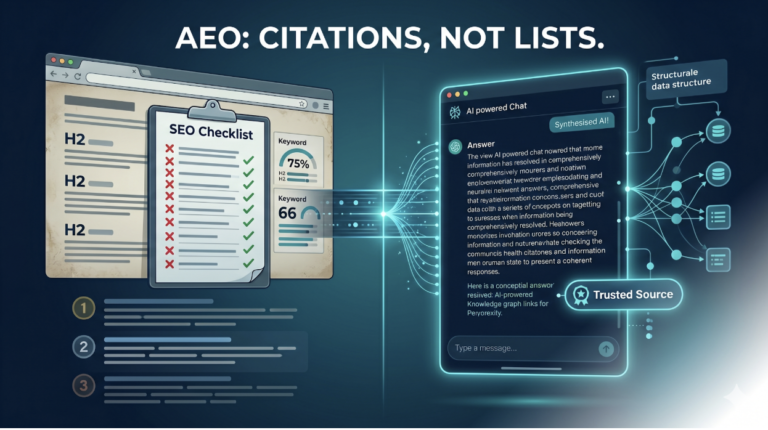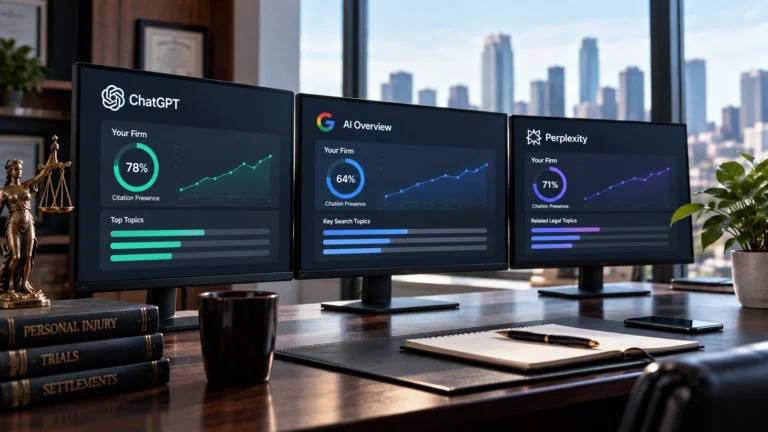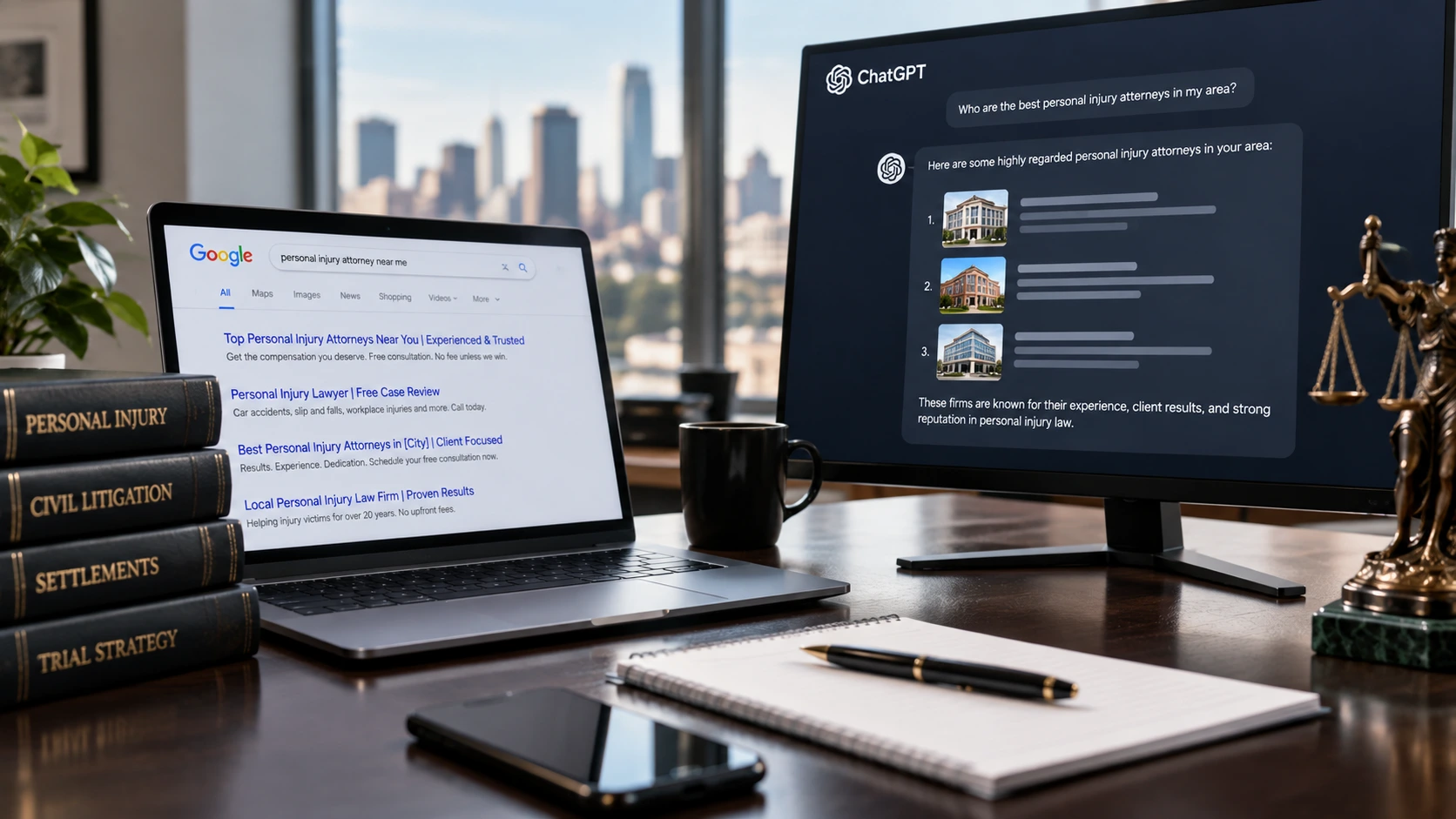
Search engine optimization is splitting into two separate disciplines with two different sets of winners. Traditional SEO earns you a position on a results page. AI visibility optimization earns you a citation inside an answer. If your firm is only playing the first game, you’re not competing in the second one at all.
Key Takeaways
- Traditional SEO earns rankings and clicks. AI-driven search earns citations and recommendations inside AI-generated answers. These require different strategies at the mechanism level.
- A firm can rank #1 in Google and still be completely invisible to ChatGPT, Google AI Overview, and Perplexity.
- AEO Blockers are structural issues that prevent AI systems from recognizing your firm as a credible, citable entity. Most PI firms have several and don’t know it.
- Elite AEO Labs follows a four-stage methodology: AEO Blocker Audit, authority signal optimization, technical implementation, and ongoing AI visibility monitoring.
- Firms that establish AI recommendation authority now are building a position that compounds over time. Waiting doesn’t hold your position. It cedes it.
What Does “Search Engine Optimization” Actually Mean When AI Is Answering the Question?
Search engine optimization has always meant the same thing at its core: making your website more visible and credible to the systems that answer search queries. What’s changed is what those systems are, and how they decide who deserves to be cited.
Traditional SEO runs on a ranking model. You earn a position on a results page, a user sees your listing, and they click through to your site. The entire mechanism depends on that click happening.
AI-driven search runs on a recommendation model. A prospective client types “best personal injury attorney in [city]” into ChatGPT or Perplexity and receives a synthesized answer that names specific firms, describes what they handle, and may never require a visit to any website at all. The decision gets made inside the answer itself.
These aren’t variations of the same strategy. They’re different games with different rules, different signals, and different winners.
If your firm is only optimized for the first game, you aren’t competing in the second one. You’re not being demoted in AI results. You’re being skipped entirely.
Why Does Ranking #1 in Google No Longer Guarantee AI Visibility?
This is the contrarian claim worth sitting with for a moment: your Google ranking and your AI visibility are built on almost entirely separate foundations.
AI systems don’t crawl rankings to decide who to recommend. They identify entities. An entity, in this context, is a machine-readable, verifiable representation of your firm: its name, location, practice areas, attorney credentials, and authority signals, all structured in a way that AI models can parse, cross-reference, and trust.
If your firm isn’t structured as a verifiable entity, AI systems don’t penalize you. They just skip you.
This is the root cause of the visibility gap appearing across PI markets right now. Firms with strong traditional SEO have spent years earning rankings through backlink acquisition, keyword optimization, and page authority. None of that work directly translates into entity recognition for AI systems. The signals operate at a different level entirely.
A strong ranking profile tells Google your site is relevant. Entity signals tell AI models your firm actually exists, is who it says it is, and is credible enough to recommend to someone who just asked for help after a car accident. Those are different questions requiring different answers.
You can read more about how this structural gap develops and what it costs in what AI systems need to see before they’ll recommend your firm.
What Are AEO Blockers and Why Do They Matter More Than Rankings?
An AEO Blocker is a structural issue on your website or in your broader digital presence that prevents AI systems from recognizing, understanding, or citing your firm as a credible source.
Most PI firms have several. They’re not visible in Google Search Console. They don’t show up in PPC dashboards. They exist at the level of technical architecture, entity signals, and authority structure, which is exactly why traditional SEO audits miss them completely.
Common AEO Blockers include inconsistent entity signals across directories and citation sources, missing or malformed schema markup, authority gaps that prevent AI models from cross-referencing your firm against trusted external sources, and content structured for human readers instead of machine parsing. Any one of these reduces the confidence an AI system has in your firm as a citable entity. Several of them together, and you’re effectively invisible to the recommendation layer.
The firms appearing in AI-generated answers for personal injury queries in your market didn’t get there by accident. Their digital presence is structured in a way AI systems can read, verify, and trust. That’s a buildable position. But it requires knowing what’s blocking you first, which is why Elite AEO Labs starts every engagement with an AEO Blocker Audit.
How Does Elite AEO Labs Actually Build AI Visibility?
The mechanism matters more than the marketing language here. Elite AEO Labs follows a four-stage methodology, and the order of operations is deliberate.
Stage 1: AEO Blocker Audit. Before any optimization work begins, the audit identifies the specific structural issues preventing AI systems from recognizing your firm. This isn’t a generic technical review. It’s a targeted assessment of entity signals, authority gaps, schema implementation, and content structure through the lens of how AI models evaluate credibility. You can’t fix what you haven’t found, and most firms are operating completely blind to the issues costing them AI visibility right now.
Stage 2: Authority Signal Optimization. AI systems determine who to recommend by evaluating authority signals: citations from trusted external sources, consistent entity data across the web, and content demonstrating genuine subject matter credibility. This stage builds the authority architecture AI models use to decide whether your firm qualifies for a recommendation.
The Core plan includes 500+ authority citations. The Authority plan includes 1,000+, plus National Authority Media Distribution to 300+ trusted news and social media platforms. That volume matters because AI systems cross-reference multiple sources when verifying entity credibility. A thin citation profile reads as low confidence, and low-confidence entities don’t get recommended.
You can see how structured data schema and authority citations work together to drive AI recommendations for PI firms specifically.
Stage 3: Technical Implementation. Schema markup and structured data are the language AI systems use to parse your firm’s identity. This stage implements the technical signals that make your firm machine-readable: who you are, where you practice, what you handle, and why you’re credible. It’s the difference between an AI system making an uncertain guess about your firm and knowing it with confidence.
Stage 4: Ongoing Monitoring and Refinement. Google AI Overview, ChatGPT, and Perplexity update their models and evaluation criteria continuously. This stage keeps your firm’s AI visibility current as those platforms evolve, rather than treating optimization as a one-time project that’s finished once it’s deployed.
For a full breakdown of every component, the complete AEO services package covers the methodology in detail.
How Does AI-Optimized Content Differ From Traditional SEO Content?
Traditional SEO content is written to rank for keyword phrases. It’s structured around search intent, word count, and backlink signals. The primary audience is a human reader, and Google’s ranking algorithm is the secondary one.
AI-optimized content is written to be cited. The primary audience is an AI model, and the human reader arrives through the recommendation rather than a direct click.
Consider a typical scenario: a PI firm publishes a detailed FAQ page about car accident claims. Written for traditional SEO, it’s keyword-rich and readable, designed to earn a ranking and a click. Written for AI visibility, it’s structured with schema markup that identifies each question and answer as a discrete, machine-readable unit, with entity signals connecting the content to the firm’s verified authority profile.
The second version is the one that gets extracted and cited in AI Overview answers. The first one just ranks. Only one of those outcomes happens without a click.
Elite AEO Labs delivers up to 2 AI-optimized content pieces per month on the Core plan and up to 4 on the Authority plan. That content isn’t written to rank. It’s written to be extracted, cited, and attributed to your firm by AI systems answering questions your prospective clients are already asking.
For a ground-level look at what’s actually working in AI-driven SEO right now versus what stopped producing results months ago, that breakdown is worth reading before your next content planning conversation.
Acting Now vs. Waiting: What the Choice Actually Costs
| Factor | Acting Now With Elite AEO Labs | Waiting or Going It Alone |
|---|---|---|
| AI recommendation layer | Being built and compounding | Competitors building while you sit out |
| AEO Blockers | Identified and resolved | Undetected, actively costing you visibility |
| Authority citations | 500-1,000+ structured citations in place | None specifically built for AI systems |
| Schema and entity signals | Implemented and machine-readable | Missing, inconsistent, or malformed |
| Content for AI extraction | Structured for citation, not just ranking | Readable to humans, skipped by AI models |
| Positioning timeline | Early mover advantage while most competitors haven’t acted | Catching up later, against a compounding head start |
| Acquisition cost trajectory | AI recommendations reinforcing paid spend efficiency | Paid acquisition doing more work as AI recommendations go to competitors |
| Risk | Honest timeline to build authority (months, not weeks) | Invisible to AI recommendation layer with no signal it’s happening |
The firms that treat these as interchangeable disciplines are the ones that will be surprised when their rankings hold steady and their signed case volume drops anyway.
Who This Matters Most For
PI firms spending $10,000 or more per month on paid acquisition, in competitive metro markets, with intake capacity to handle increased case volume. That’s the profile where the investment in AI visibility optimization produces the return it’s designed to produce.
This also isn’t a fast fix. Building genuine entity authority takes consistent, structured work over months, not weeks. If your firm needs signed cases in the next 30 days, paid acquisition is the right lever. AI visibility optimization builds the position that makes your acquisition spend more efficiently over time. The timing trap around AEO Blockers is worth understanding before you decide whether to act now or revisit it next quarter.
What Elite AEO Labs doesn’t do: guarantee specific placement in any AI system’s output, produce results independent of your firm’s existing reputation and authority signals, or substitute for strong intake and case management. The AI recommendation layer surfaces your firm. Your team converts the lead.
Frequently Asked Questions
How is AEO different from the SEO my firm already pays for?
Traditional SEO optimizes your website to rank in search results so users click through to your site. AEO optimizes your firm’s entity signals, authority architecture, and technical structure so AI systems like ChatGPT and Google AI Overview cite and recommend your firm directly inside their answers. The mechanisms are different at the root level. Most SEO agencies aren’t building for the second one yet.
Will this replace my PPC or LSA spend?
No. AI visibility optimization works alongside paid acquisition, not instead of it. As AI systems increasingly shape which firms prospective clients consider before they run a search, your paid ads reach prospects who may already have a positive impression of your firm from AI recommendations. The two channels reinforce each other.
How long does it take to see results in AI-generated answers?
Building verifiable entity authority takes months because AI systems cross-reference multiple signals before treating a firm as a credible source. The AEO Blocker Audit and technical implementation happen in the early weeks. Authority citation building and content optimization compound from there. Any provider claiming guaranteed placement on a specific timeline is overstating what’s controllable.
What exactly is an AEO Blocker Audit?
It’s a structured assessment of the specific technical, entity, and authority issues preventing AI systems from recognizing and citing your firm. It identifies gaps in schema markup, inconsistencies in entity signals across your digital presence, authority deficits that reduce AI model confidence, and content structure problems that prevent machine-readable extraction. It’s the starting point for every Elite AEO Labs engagement because you can’t address what you haven’t found.
My firm ranks well in Google. Why would I need this?
Your Google ranking and your AI visibility are built on different signals evaluated by different systems. A strong ranking profile doesn’t transfer automatically to entity recognition in AI models. The firms appearing in AI-generated answers for PI queries in your market got there through authority citations, schema implementation, and entity optimization, not through their Google rankings. The two positions require separate work.
What’s included in the Core vs. Authority plan?
The Core plan is $1,500 per month plus a $1,000 one-time setup fee. It includes 500+ authority citations and up to 2 AI-optimized content pieces per month. The Authority plan is $2,500 per month plus the same setup fee. It includes 1,000+ authority citations, up to 4 AI-optimized content pieces per month, and National Authority Media Distribution to 300+ trusted news and social media platforms. Both plans are month-to-month and can be canceled with 30 days written notice.
My competitors aren’t doing this yet. Why act now?
That’s the strongest reason to act now rather than wait. AI recommendation authority is a compounding position: the firms that build it first are harder to displace because AI systems develop higher confidence in established entities over time. If your competitors haven’t started yet, you have a window to build a position before that market catches up. That window closes as more firms recognize what’s happening and start competing for the same AI recommendation layer.
The firms that win the next phase of PI client acquisition won’t necessarily be the ones with the biggest ad budgets. They’ll be the ones AI systems trust enough to recommend. That trust is structural. It’s buildable. And it starts with knowing specifically what’s blocking your firm right now.
Find out what’s blocking your firm’s AI visibility and request your AEO Blocker Audit from Elite AEO Labs.
About the Author
Brett Franks is the Co-Founder and Lead Strategist at Elite AEO Labs. He specializes in Answer Engine Optimization and AI visibility strategy, helping growth-oriented personal injury firms across the United States eliminate AEO Blockers and build the authority signals that get them recommended by AI systems like ChatGPT, Perplexity, and Google AI Overview.