Your dashboards say everything is fine. Rankings are holding. PPC is running. But your intake team is quieter than it should be. That gap between what your reporting shows and what your phones are doing is where AI recommendation drift operates, and it’s already affecting firms that have no idea it’s happening.
Direct Answer
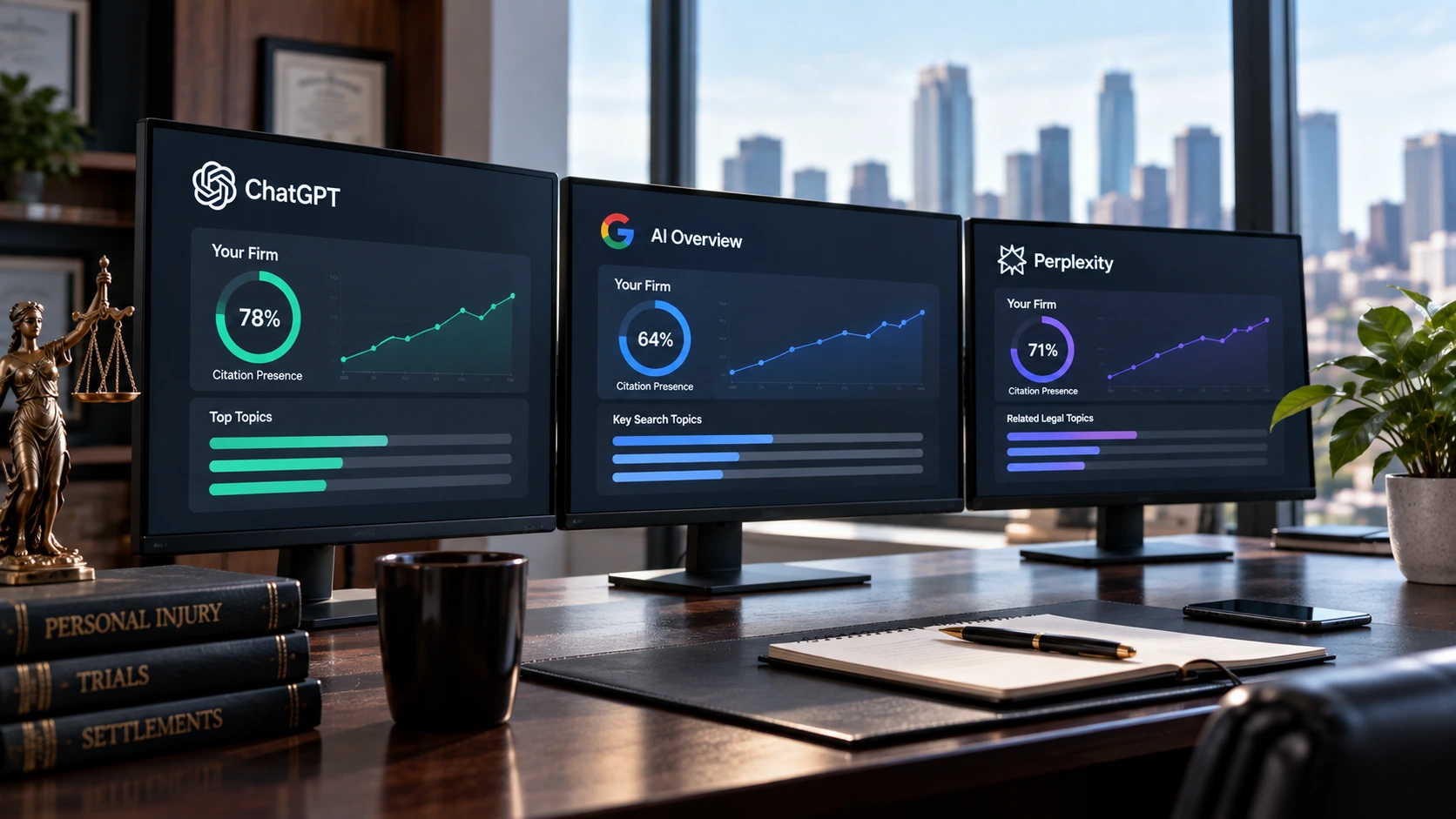
Ongoing AI recommendation monitoring means tracking citation presence across platforms like ChatGPT, Google AI Overview, and Perplexity, catching structural signal degradation before it reaches your lead flow, and refining entity data, schema, and authority citations as AI systems update how they evaluate sources. It’s a continuous process because AI platforms continuously re-evaluate which firms deserve to be cited. What qualified your firm for a recommendation last quarter may not qualify it today.
Key Takeaways
- AI systems re-evaluate citation eligibility on a rolling basis, so visibility can erode without any change on your end.
- Schema markup and structured data degrade silently through site updates, theme changes, and plugin conflicts.
- The failure mode for AI visibility doesn’t appear in standard analytics. You won’t see a ranking drop first. You’ll see a lead drop.
- Platform-specific tracking matters because ChatGPT and Google AI Overview weigh authority signals differently.
- Treating AEO optimization as a completed project is the most reliable way to lose the ground you built.
Why Can’t AI Visibility Just Be Set Once?
Most firms arrive at this question with a traditional SEO mental model. You optimize a page, earn some links, the ranking holds until something significant changes. That model worked because search engines evaluated pages slowly and leaned heavily on historical signals.
AI recommendation systems don’t hold historical positions. They evaluate whether your firm qualifies as a citable authority at the moment of each query. The real-time question is whether your entity signals are coherent, whether your structured data is parseable, and whether your authority citations confirm what your site claims about itself. If any of those signals have drifted, your citation eligibility drops.
This is the mechanism most firms miss when they treat initial AEO work as a finish line. The AI isn’t remembering that you were well-optimized six months ago. It’s asking right now.
Waiting until you notice a drop in leads to investigate is the equivalent of checking your oil after the engine seizes.
What Ongoing Monitoring Actually Tracks
Surface-level monitoring asks: is our firm appearing in AI answers? That question is too coarse to be useful. By the time citation absence shows up at that level, the underlying signal problems have usually been compounding for weeks.
Effective monitoring tracks several distinct signal categories simultaneously.
Citation presence by platform. Each major AI platform uses different weighting criteria. A firm can appear consistently in ChatGPT responses and be nearly invisible in Google AI Overview because the two systems weight structured data and entity recognition differently.
Understanding how AI search engines choose which firms to recommend helps clarify why platform-specific variation matters far more than most firms realize. Aggregate monitoring misses this distinction entirely.
Entity recognition accuracy. AI systems build an internal model of your firm: what legal categories you cover, what geography you serve, how authoritative you appear within those categories, and how consistently that picture is confirmed across the web. When one citation source lists a different practice area or a directory still carries an old address, that introduces contradiction into the model. Contradictory entity signals reduce citation confidence. Monitoring catches this drift before it accumulates. You can dig deeper into why that matters in this breakdown of entity optimization for personal injury firms.
Schema and structured data integrity. Schema markup doesn’t hold indefinitely. Site updates, theme changes, and CMS plugin conflicts can silently invalidate the structured data that tells AI systems how to interpret your content. This is one of the reasons structured data and authority citations shape AI recommendations in ways that require active maintenance, not just initial implementation.
Competitor citation tracking. Consider a scenario where a competing firm in your metro begins appearing consistently in AI answers for the searches your firm should be owning. The competitor isn’t just gaining visibility. They’re building relative authority that causes AI systems to weigh every other firm in that category with less confidence. The window to respond narrows the longer that authority builds unchallenged.
The Refinement Cycle: What Gets Adjusted
Monitoring without refinement is just watching the problem develop.
The refinement component of Elite AEO Labs’s work involves targeted adjustments based on what monitoring surfaces. The Core plan includes 500+ authority citations and the Authority plan includes 1,000+. But citations aren’t static assets. Citation consistency degrades when directories update their records, when new platforms emerge that AI systems begin weighting, and when existing citations conflict with updated firm information. Refinement keeps the citation profile coherent and current.
Content signal updates are another component. AI-optimized content isn’t written once and archived. As AI platforms shift what they treat as authoritative, whether that’s explanation depth, entity co-occurrence, or topical specificity, existing content can fall below the threshold for citation eligibility. The Core plan includes up to 2 AI-optimized content pieces per month and the Authority plan includes up to 4, specifically to keep that content layer current rather than static.
Schema refinements respond to platform updates. When Google adjusts how it processes LegalService or LocalBusiness schema, firms that don’t update their markup fall out of the structured data layer that AI systems use to verify entity claims. This happens without any visible signal in standard analytics.
The Authority plan also includes National Authority Media Distribution to 300+ trusted news and social media platforms. That distribution builds a distributed citation footprint across authoritative sources, which increases AI systems’ confidence in a firm’s claimed category and geography. The complete AEO services package details exactly what’s included in each plan.
Ongoing Monitoring vs. Waiting or Going It Alone
| What Gets Evaluated | Ongoing Monitoring With Elite AEO Labs | Waiting, Going It Alone, or Treating It as Finished |
|---|---|---|
| Citation presence tracking | Platform-specific across ChatGPT, AI Overview, and Perplexity | Manual name checks, or none at all |
| Schema integrity | Continuous, with refinement triggered by detected breaks | Discovered after leads have already dropped |
| Entity signal consistency | Tracked and corrected across citation sources | Invisible until contradiction has already accumulated |
| Competitor citation gains | Flagged early with a refinement response | Noticed only after they’ve established durable authority |
| Content currency | Updated monthly to match evolving AI evaluation criteria | Static until someone decides to revisit it |
| Response to platform changes | Built into the ongoing process | Requires knowing a change happened in the first place |
The cost of the wrong call here isn’t the monthly fee. It’s the cost of a competitor establishing citation authority in your market while your signals drift unchecked. Understanding how AI-driven search differs from traditional SEO makes clear how quickly that gap compounds in one direction or the other once it starts.
Who Needs This Most Urgently
Urgency scales directly with competitive pressure and acquisition spend.
Consider a PI firm spending heavily on PPC and LSAs in a competitive metro. That firm is already operating in an environment where AI recommendation drift is expensive. The cost per signed case is high. The organic trust layer that AI recommendations provide, where a prospective client encounters your firm in a synthesized answer before they ever click on anything, is a meaningful part of your acquisition environment. Losing that layer pushes cost-per-case higher with no corresponding improvement in case quality.
The future of zero-click search isn’t a distant concern for firms at that level of spend. It’s already shaping where prospective clients first encounter law firm recommendations, and the firms building citation authority now are establishing a position that becomes genuinely difficult to displace over time.
If you’re in an expansion phase, adding attorneys or scaling intake, this is the right moment to build monitoring infrastructure. It costs significantly less to maintain AI visibility than to rebuild it after a competitor has established consistent citation authority in your market.
Honest Answers on Timelines and Outcomes
AI visibility improvements don’t happen overnight. Elite AEO Labs’s four-stage process begins with an AEO Blocker Audit that identifies the structural issues preventing AI systems from recognizing and citing your firm. Resolving those creates the foundation. But AI systems require time to re-crawl, re-evaluate, and update their entity models before those improvements register as citation presence.
What this work doesn’t do: it doesn’t guarantee specific case volumes, and it isn’t a replacement for paid acquisition. What it builds is the organic authority layer that makes every other acquisition channel more efficient, because prospects who find your firm through any channel encounter consistent, AI-recognizable signals of authority when they investigate further.
It also doesn’t work for firms that treat it as a one-time project. That’s not a hedge about the methodology. It’s a structural fact about how AI evaluation works. The only scenario where ongoing monitoring fails to hold ground is when it stops.
Services run month-to-month with no long-term contract. There’s a one-time $1,000 setup fee. The Core plan is $1,500 per month and the Authority plan is $2,500 per month. Either plan can be canceled with 30 days written notice. That structure reflects confidence in the ongoing work rather than a reliance on locked-in commitments.
When you’re ready to stop guessing about your firm’s position in AI-generated answers, contact Elite AEO Labs to get started.
Frequently Asked Questions
How often does Elite AEO Labs check AI recommendation presence?
Monitoring runs on an ongoing basis, not just at monthly reporting intervals. AI systems can update citation behavior in response to model changes, competitor activity, or changes in your site’s structured data. A monthly-only check creates too long a gap between a problem developing and a response being made.
What happens if a competitor starts appearing more often in AI answers than we do?
Competitor citation gains are tracked as part of the monitoring process and trigger a refinement review. The signals driving the competitor’s improved citation presence get identified, and adjustments to your firm’s entity signals, content, or schema are made to close the gap. Responding quickly matters because AI citation patterns can become self-reinforcing once a competitor builds consistent authority signals across enough sources.
Does ongoing monitoring include updates to our website content?
Yes, within the scope of the AI-optimized content pieces included in each plan. The Core plan includes up to 2 AI-optimized content pieces per month and the Authority plan includes up to 4. These are written specifically to strengthen the entity signals and topical authority that AI systems use to evaluate citation eligibility, not generic blog content.
Can we manage this monitoring ourselves?
You can check manually whether your firm’s name appears in AI answers. That’s a surface check. Effective monitoring involves tracking entity consistency across citation sources, schema integrity, structured data parsing, and platform-specific citation patterns across multiple AI systems simultaneously. Firms that try to manage this internally typically discover the gaps only after those gaps have already affected lead volume. What’s involved is covered in detail in how AEO optimization actually works.
What if AI platforms change their evaluation criteria significantly?
That’s exactly what the refinement component addresses. AI platforms do update how they evaluate authority and what structured data they recognize. The monitoring process is designed to catch those shifts early and adjust your firm’s signals before visibility drops. How AI search engines select the verified answer explains why treating AEO as a one-time optimization doesn’t hold in an environment that keeps changing.
Is there a long-term contract?
No. Services are delivered month-to-month and can be canceled with 30 days written notice. There’s a one-time $1,000 setup fee, after which the monthly plan runs without a long-term commitment.
How do we know if the monitoring is working?
The measure that matters is citation presence in AI-generated answers for the searches your prospective clients are actually running. That’s tracked directly, not inferred from traffic or rankings. If your firm is being cited more consistently across AI platforms over time, the monitoring and refinement are working. If citation presence plateaus or drops, that triggers a refinement review rather than a report that says everything looks fine.
Brett Franks is the Co-Founder and Lead Strategist at Elite AEO Labs. He specializes in Answer Engine Optimization (AEO) and Generative Engine Optimization (GEO), helping firms transition from traditional SEO to AI-driven authority by ensuring they’re recognized and cited by AI models including ChatGPT, Perplexity, and Google AI Overview. Elite AEO Labs works with personal injury firms across the United States to eliminate AEO Blockers and build the entity authority that drives AI recommendations.