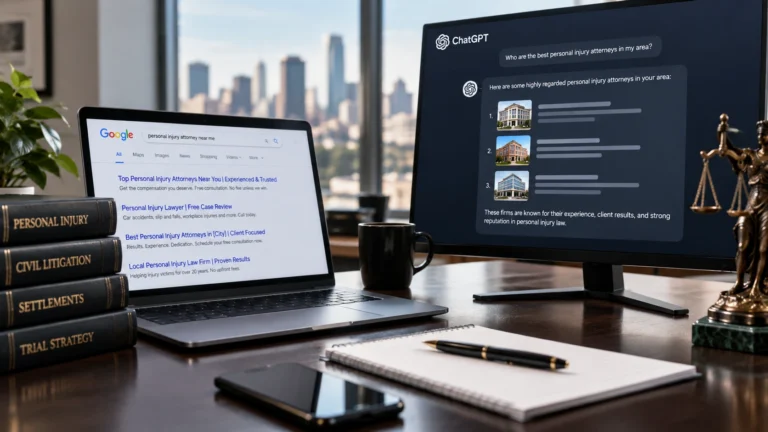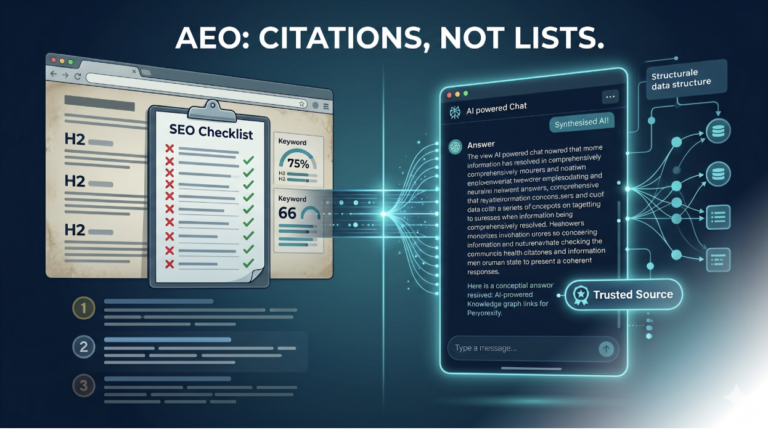
Continuous AI Visibility Monitoring tracks whether AI systems are actively citing or recommending your firm in response to the queries your prospective clients are asking right now. It matters because AI recommendations shift over time. A firm appearing consistently in ChatGPT or Google AI Overview this month may not appear next month, and the standard analytics tools your firm relies on won’t show you when that happens.
Key Takeaways
- A firm can hold the top organic ranking in Google and still be completely invisible in AI-generated answers where a growing share of prospects form their decisions.
- AI recommendation visibility isn’t static. Authority signals age, competitors gain ground, and a firm’s standing in AI answers can erode without any visible change in rankings or PPC performance.
- Your current analytics tools weren’t built to detect AI visibility loss. They measure activity that starts after a prospect engages. They can’t track the prospect who asked an AI for a recommendation, received a competitor’s name, and called that firm directly.
- The strongest results come from firms that treat AI visibility as an ongoing management discipline, not a one-time project.
- Stopping monitoring doesn’t hold your position. It cedes it while leaving you no mechanism to detect the loss before it reaches intake.
What Does Continuous AI Visibility Monitoring Actually Track?
Most PI firms measure their digital presence through rankings, ad performance, and website traffic. Those metrics capture what happens after a prospect decides to engage with your content. They don’t capture what happens when a prospect asks ChatGPT or Google AI Overview which personal injury attorney to call, receives a recommended name, and dials that firm directly.
Continuous AI Visibility Monitoring tracks whether AI systems are citing or recommending your firm in response to the query types your prospective clients actually use. It runs persistently because AI recommendations aren’t a one-time determination. The systems generating those answers pull from continuously updated authority signals, and a firm’s standing can shift without any corresponding movement in rankings or paid acquisition metrics.
Understanding how AI search engines choose which firms to recommend is the starting point for understanding why monitoring has to be continuous rather than periodic. The recommendation logic is ongoing. So is the competitive pressure affecting your position within it.
Why Does AI Visibility Decay Without Active Management?
There’s a causal chain behind AI visibility erosion that most firms don’t recognize until it’s already affected their intake.
AI systems evaluate authority signals on an ongoing basis. Those signals include entity consistency across directories, schema markup integrity, citation frequency from credible sources, and content structured so that AI can extract and attribute a specific answer. When any of those inputs degrade or go stale, an AI system’s confidence in recommending your firm decreases.
The decay isn’t dramatic. It won’t surface as a Google penalty or a sudden ranking drop. It shows up first as intermittent appearances in AI answers rather than consistent ones, and then as an absence from the recommendation set entirely for certain query clusters.
A competitor doesn’t need to do anything aggressive to take your position. They just need to maintain their authority signals while yours quietly age.
That’s what makes the financial exposure so easy to miss. The recommendation decision happens inside the AI answer, before a prospect ever visits your site. A firm that’s invisible in that layer isn’t losing click-through rate. It’s losing prospects who never entered its funnel at all, and those losses won’t appear in any dashboard the firm is currently watching.
What Strong ROI From Monitoring Actually Looks Like
Strong results from Continuous AI Visibility Monitoring don’t arrive as a spike. They accumulate as a compounding curve, and the mechanism behind that curve is specific.
Consider how this plays out in a typical situation. A PI firm running substantial monthly PPC spend completes an AEO Blocker Audit and surfaces structural problems. Entity signals may be inconsistent across directory listings. Schema markup may be absent from key practice area pages. Content may be written broadly enough that AI systems can’t extract a citable, attributable answer from it. Each of those problems is a structural blocker, not a content quality issue.
Once blockers like those are identified and resolved, monitoring provides the feedback loop that confirms whether the fixes are producing the intended signal improvements, and flags any new gaps before they compound into something harder to correct. What that kind of feedback loop often reveals isn’t a single breakthrough moment. It’s incremental stabilization: citation frequency for local queries becoming more consistent, appearance in AI Overview responses for comparative searches growing more reliable over time.
The detail that separates firms with strong results from firms with weak ones isn’t the quality of the initial audit. It’s whether they stayed in the feedback loop long enough for authority signals to compound. AI systems weight recency and consistency. A firm that demonstrates sustained, coherent authority signals over time builds a position that’s genuinely harder for a competitor to displace.
What Weak Results Look Like and the Pattern Behind Them
Weak results from AI visibility work trace back to a specific decision: treating the initial optimization as the finish line.
Picture a firm that completes the audit, resolves the identified blockers, and exits the monitoring process. In the weeks that follow, a competitor may publish new content with tighter entity signals. A directory listing could go stale after a site migration. A schema implementation might break during a routine update that no one flagged as affecting structured data. None of this would surface in Google Analytics. Rankings might stay flat. Then, if intake starts softening, it’s easy to attribute the shift to seasonality or market fluctuation rather than trace it back to its actual source.
That’s the trap.
The instinct in that situation is often to increase PPC spend, because the visible metrics look normal. But paid traffic can’t solve an AI visibility problem. The recommendation decision has already been made inside the AI answer before a prospect ever reaches your ad. The honest tradeoff analysis between AEO optimization and the alternatives addresses this directly, including what firms often find when they trace intake softening back to its actual source.
Why Your Current Metrics Can’t Show You This Problem
Your existing analytics setup wasn’t built to measure AI recommendation visibility. That’s not a criticism of the tools. It’s a structural fact about what they were designed to do.
Click-through rates, impression share, cost per click, and cost per signed case all measure activity that begins after a prospect has already decided to engage. A prospect who asks an AI system for a recommendation, receives one for a competitor, and calls that firm has never touched your funnel at all. There’s no bounce rate to flag it. There’s no cost-per-click entry to record it.
This is precisely why stopping AI recommendation monitoring is one of the highest-cost decisions a PI firm can make. The cost isn’t the monthly service fee. The cost is the case volume quietly redirecting to a competitor whose AI visibility is being actively managed while yours is degrading. Monitoring closes this blind spot by tracking recommendation frequency across the platforms your prospects actually use and catching citation rate drops before they become intake problems.
The Three Stages of AI Visibility Standing
It helps to think about AI recommendation standing as falling into one of three stages.
At the stable stage, your firm appears consistently across AI platforms for your core query set. Entity signals are current, schema is intact, and authority citations are being refreshed regularly. Monitoring confirms the position is holding and flags anything that could threaten it.
At the drifting stage, your firm appears intermittently. Citation frequency varies across sessions. Traditional metrics haven’t moved yet, which is exactly why most firms don’t recognize this stage as a problem until it’s progressed. This is the highest-leverage intervention point, because the position hasn’t been lost yet. It’s just becoming unreliable.
At the eroding stage, your firm has dropped out of AI recommendations for primary query clusters entirely. A competitor holds the recommended position. Recovery takes longer than prevention from the drifting stage, because a competitor cited reliably for months has built a consistency advantage that requires sustained, focused effort to overcome.
If your intake numbers are softening without a clean PPC explanation, the drifting stage is where to look first. Understanding what AEO blockers actually are helps clarify what’s likely driving the drift before the situation progresses to the third stage.
How Elite AEO Labs Structures the Monitoring Process
Elite AEO Labs builds monitoring into its service from the start, not as an add-on, but as the mechanism that makes everything else hold over time.
The four-stage methodology begins with an AEO Blocker Audit to identify the structural issues preventing AI systems from understanding or citing your site. Authority signals and content are then optimized for AI readability and credibility. Technical enhancements, including schema markup and structured data implementation, strengthen entity recognition. The fourth stage is ongoing monitoring and refinement, which adapts the site continuously as AI platforms evolve.
The Core plan is $1,500 per month plus a one-time $1,000 setup fee, and includes 500 or more authority citations and up to two AI-optimized content pieces per month. The Authority plan is $2,500 per month plus the same setup fee, and includes 1,000 or more authority citations, up to four AI-optimized content pieces per month, and national authority media distribution to 300 or more trusted news and social media platforms. Both plans are billed monthly and can be canceled with 30 days written notice.
The authority citations aren’t a one-time signal. They’re a recurring input that AI systems use to assess whether your firm is a current, credible source. Stopping citation building is structurally similar to stopping a PPC campaign and expecting the leads to continue. You can review the full service structure at the complete AEO services package page.
Worth being direct about one genuine limitation: monitoring is a feedback mechanism. It tells you whether your content and citation work is producing AI visibility, which query clusters still have gaps, and where a competitor is gaining ground. It doesn’t replace weak content, repair a broken intake process, or compensate for entity signal problems that haven’t been structurally addressed. The audit and optimization work is what gives the monitoring loop something meaningful to measure. How Elite AEO Labs builds AI visibility for personal injury firms walks through the full sequence and where ongoing monitoring fits within it.
Acting Now vs. Waiting: A Direct Comparison
| Factor | Acting Now With Elite AEO Labs | Waiting, Going It Alone, or Doing Nothing |
|---|---|---|
| AI recommendation visibility | Actively tracked, flagged, and corrected before intake is affected | Unknown until case volume has already dropped |
| Authority signal decay | Caught at the drifting stage, when correction is still straightforward | Accumulates silently until the eroding stage |
| Competitor gains AI position | Detected through monitoring; response is immediate | Discovered after the position is already lost and compounding |
| Existing PPC spend | Supported by AI visibility driving unpaid recommendations in parallel | Paid traffic competes against AI answers favoring a competitor |
| Recovery timeline if ground is lost | Shorter, because intervention happens before the competitor’s consistency advantage compounds | Longer, because sustained competitive authority takes time to displace |
| Financial exposure | Contained through early detection | Scales with every month of undetected drift |
The cost that matters isn’t the monthly service fee. It’s the case volume redirecting to a competitor while your metrics show everything looks fine.
Frequently Asked Questions
How long does it take to see results from Continuous AI Visibility Monitoring?
Monitoring produces signal immediately, but meaningful shifts in AI recommendation frequency typically take 60 to 90 days to become visible. That timeline reflects how AI systems update their evaluations and how authority signals accumulate over time. A site with significant unresolved blockers at the outset will take longer to show movement than one where the foundational structure was clean from the beginning.
What exactly is being monitored?
Monitoring tracks your firm’s citation and recommendation frequency across AI platforms including ChatGPT, Google AI Overview, and Perplexity, for the specific query clusters your prospective clients use. The measurement is whether your firm appears, how consistently it appears, and whether that frequency is stable, improving, or declining compared to prior periods.
If my Google rankings are strong, why does AI monitoring matter?
AI systems don’t pull their recommendations directly from search rankings. The recommendation decision happens inside the AI answer, before any ranking is consulted. A firm can hold the top organic position and still be completely invisible in the AI layer where a growing share of prospects are forming their decisions. How AI search has diverged from traditional SEO explains the structural reasons behind that gap.
What happens if I stop monitoring after the initial optimization?
AI visibility can decay without active maintenance because authority signals age, competitors publish new content with stronger entity clarity, and AI platforms update how they evaluate sources. Stopping monitoring doesn’t hold your position. It cedes it while leaving you no mechanism to detect the loss before it affects intake.
Is this only relevant for large PI firms?
It’s most directly relevant for firms spending $10,000 or more per month on acquisition, regardless of headcount, because that’s the level where the financial exposure from undetected AI visibility loss is significant enough to justify active management. If a meaningful share of prospective clients are forming decisions inside AI answers, and those answers are recommending a competitor, the cost accumulates every month that gap stays open.
How does monitoring interact with the content and citation work?
Monitoring is the feedback mechanism that tells you whether the content and citation work is producing AI visibility. Without it, you’re optimizing without any way to confirm it’s working. With it, you can see which content pieces are generating citation frequency, which query clusters still have gaps, and where a competitor is gaining ground so the optimization work gets directed toward the highest-impact areas.
Can I run an audit once and skip the ongoing monitoring?
You can. It’s also the most common reason firms see initial improvement followed by gradual, invisible decline. The audit identifies and resolves existing blockers at a point in time. Monitoring is what catches new ones before they compound. Given that AI systems continuously re-evaluate authority signals across your entire competitive set, a one-time audit without ongoing monitoring is a starting point, not a complete strategy.
If your intake is softening and your paid acquisition metrics look clean, the explanation may be in the layer your current tools aren’t measuring. Request your AEO Blocker Audit and find out exactly where your firm stands in AI recommendations before a competitor uses that gap against you.
Brett Franks is the Co-Founder and Lead Strategist at Elite AEO Labs, where he specializes in Answer Engine Optimization, Generative Engine Optimization, and semantic entity building for businesses navigating the shift from traditional search to AI-driven discovery. His work focuses on helping brands become recognized, cited, and recommended by AI systems including ChatGPT, Perplexity, and Claude. Elite AEO Labs provides done-for-you AI Visibility and Authority Optimization services for growth-oriented personal injury firms across the United States.