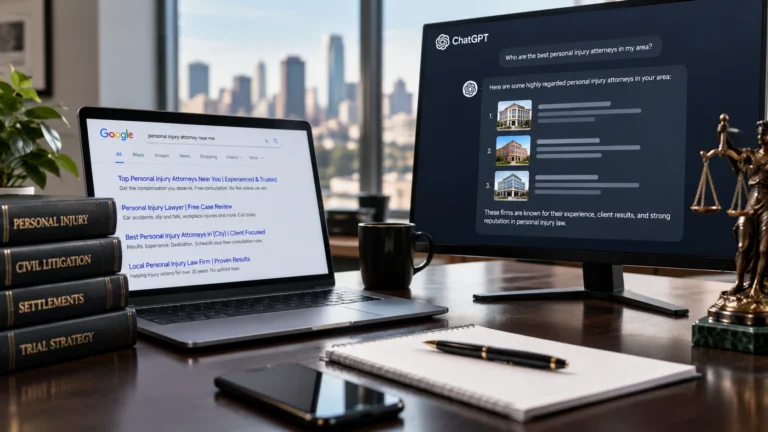
When a prospective client asks ChatGPT which personal injury firm to call in your city, the AI doesn’t check your Google ranking. It looks for entities it can verify: consistent, cross-referenced, and structurally legible to machine-reading systems. If your firm doesn’t meet that standard, it isn’t penalized. It’s simply not there.
Key Takeaways
- Authority citations signal entity identity to AI systems, not just directory presence, and consistency across those citations is what creates recognizable entity signals.
- In-house citation building often underestimates the true cost once staff time, tool access, and distribution gaps are factored in honestly.
- Elite AEO Labs builds citation volume directly into its service tiers: 500+ citations at the Core level and 1,000+ at the Authority level.
- AEO Blockers are structural problems that make citations ineffective until they’re resolved, which is why the audit comes before anything else.
- The firms building entity authority now are creating a baseline that later entrants will need to exceed, not just reach.
What Do Authority Citations Actually Do for AI Search Visibility?
Most PI firm owners picture authority citations as upgraded directory listings. Submit to enough places, the thinking goes, and AI systems find you. That’s the wrong mental model.
AI systems don’t reward volume in a search index. They identify entities that appear consistently across trusted sources, with matching signals about who that entity is, what it does, and whether independent sources treat it as credible. The mechanism is entity recognition. A firm with dozens of inconsistent directory listings registers very differently in that model than a firm with hundreds of consistent, schema-reinforced authority citations across legal media, news platforms, and structured data sources.
Consistency and coverage tell the AI your entity is stable and verifiable. Inconsistencies create ambiguity. And AI systems resolve ambiguity by mentioning someone else.
Understanding how AI search engines choose the verified answer is the foundational question before any citation strategy makes sense. Without that context, it’s easy to invest in citation volume without understanding what that volume actually needs to accomplish.
Why Do Most PI Firms Underestimate the Real Cost?
The surface-level estimate looks manageable. A marketing coordinator spends a few hours submitting to directories. Maybe a VA works through a list. It gets checked off. It feels handled.
Here’s what that estimate misses.
Citation building for AI visibility targets a different set of platforms than citation building for local SEO. The sources that carry weight with AI models include national news distribution networks, authoritative legal media, and structured data aggregators. Accessing hundreds of trusted news and social platforms requires a distribution infrastructure that most firms don’t have and can’t replicate with a spreadsheet.
There’s also a technical layer that rarely gets discussed. A citation without proper schema markup and entity signals doesn’t register the way AI systems require. A mention of your firm on a news platform carries meaningfully more weight when it’s wrapped in structured data that identifies the entity being referenced, the context, and the relevant attributes. That layer requires expertise that’s distinct from general marketing coordination.
Consider what often happens in competitive markets. A PI firm assigns citation building to a coordinator who’s also managing intake support, social media, and ad reporting. After several months, that person has typically submitted to general directories, sometimes with inconsistent name, address, or phone data across platforms, and without schema reinforcement on any of them. The citations exist on paper. The coordinator isn’t at fault. The approach was structurally insufficient from the start, because volume without consistency and structured data typically doesn’t produce the recognition signals AI models need to treat a firm as a verifiable entity.
The real costs include staff time at fully-loaded hourly rates, tool and subscription access, and the correction cost when inconsistent citations need to be cleaned up before effective work can begin. Cleanup isn’t free, and it delays any meaningful visibility gains. For firms already spending heavily on PPC and LSAs, the math looks very different once you factor in what a single additional signed case is worth.
Attempting citation building at the volume AI systems require, entirely in-house, can often become a way to feel like you’re addressing the problem without resolving the structural issues that actually determine whether AI systems recognize your firm in the first place.
How Many Authority Citations Does a PI Firm Actually Need?
Volume thresholds for AI visibility reflect the density of citation signals AI models need to treat an entity as reliably authoritative rather than tentatively present.
Elite AEO Labs structures its service tiers around that distinction. The Core plan at $1,500 per month includes 500+ authority citations and up to two AI-optimized content pieces monthly. That citation volume supports consistent AI consideration for firms in moderate-competition markets, where fewer competing entities are actively building structured entity authority at the same time.
The Authority plan at $2,500 per month includes 1,000+ authority citations, up to four AI-optimized content pieces monthly, and national authority media distribution to 300+ trusted news and social media platforms. In high-competition metro markets, where multiple well-funded firms are building entity authority simultaneously, higher citation volume is what separates occasional AI mentions from consistent AI recommendations. The mechanism is straightforward: the more competing entities are signaling credibility to the same AI models, the more signal density your firm needs to register as the reliable choice rather than simply a present one.
A $1,000 one-time setup fee applies to both plans. That covers the AEO Blocker Audit, which is where the work actually starts.
You can’t build effective citations on top of a broken entity structure. If AI systems can’t correctly identify your firm as a distinct, trustworthy entity before citations are built, those citations can reinforce existing confusion rather than resolve it. The audit identifies structural problems first. That sequence matters far more than most firms realize before they commit to a volume-first approach. How AEO optimization actually works explains why firms that skip the audit phase often see no AI visibility movement despite building substantial citation volume.
In-House vs. Working With Elite AEO Labs: What Each Path Actually Delivers
The comparison that matters isn’t whether in-house is cheaper on paper. It’s which approach actually produces AI visibility in a competitive market, and what each path costs when outcomes are honestly accounted for.
| Factor | In-House Approach | Elite AEO Labs |
|---|---|---|
| Schema and structured data | Rarely implemented correctly | Built into the methodology from the start |
| Platform reach | General directories | 300+ trusted news and media platforms |
| AEO Blocker identification | Not addressed | Audit-first, before citations are built |
| AI-optimized content | Unlikely at scale | 2 to 4 pieces per month, included |
| Estimated monthly cost | $2,000 to $5,000+ once staff time and tools are counted honestly | $1,500 to $2,500 per month |
| Entity structure | Typically unresolved | Resolved before citation building begins |
| Contract flexibility | Not applicable | Month-to-month, 30 days written notice to cancel |
The in-house cost column deserves scrutiny. A marketing coordinator at a mid-range salary costs more per hour than the base rate suggests once benefits, management overhead, and tool access are factored in. Twenty hours per month on citation work adds up quickly, and that’s before accounting for the cost of doing it incorrectly, and before the cost of fixing it later. For firms competing in high-volume metro markets, attempting this work entirely in-house, at the scale AI systems require, often produces the feeling of progress without the structural output that actually moves AI visibility.
Comparing AEO optimization against the alternatives lays out what each approach actually delivers in practical terms.
What Most Firms Won’t Hear Until It’s Too Late
Ranking number one in Google doesn’t transfer to AI visibility.
A firm can hold the top organic position in its metro market and still be completely absent from AI-generated answers. That’s not a hypothetical edge case. It’s the predictable result of two separate systems that evaluate authority through fundamentally different signals. Google measures relevance and link authority. AI systems measure entity consistency, structured data coverage, and cross-platform recognition. A firm optimized entirely for one isn’t automatically visible in the other.
Assuming your existing SEO authority carries over to AI recommendations is one of the more costly assumptions a growth-oriented PI firm can make right now. It creates a false sense of coverage that delays action during the window when action is least expensive.
The firms building citation authority now are establishing the baseline that AI models will reference as the competitive landscape solidifies. That baseline compounds. A firm entering the space significantly later isn’t starting from the same position its competitors were in when they began. It’s starting from behind a competitor who has been accumulating entity authority the entire time, which means more investment is needed to close a gap that didn’t have to exist.
Understanding the timing trap around AEO Blockers makes the compounding cost of delay specific and concrete.
One honest limitation worth stating plainly: this approach doesn’t produce results overnight. AI visibility builds through accumulated, consistent signals over time. Results in highly competitive markets depend on both the quality of the entity foundation and the actions of competing firms. Firms that exit before that foundation is fully established typically leave the work at the stage where it hasn’t yet produced what the strategy is designed to deliver.
If your firm is in an expansion phase, adding attorneys, scaling intake, and watching cost per signed case rise while ad spend holds flat, that’s the signal worth paying attention to. The acquisition environment has shifted under your existing strategy. Understanding what’s actually changed in AI-driven search gives context for why that shift often doesn’t appear in traditional metrics until it’s already affecting case volume.
The firm that becomes the AI-recommended choice in its metro market won’t get there by outspending competitors on PPC. It’ll get there by becoming the entity AI systems trust enough to mention first.
Find out what’s blocking your firm from AI recommendations by starting with the AEO Blocker Audit.
Frequently Asked Questions
How long does it take to see AI visibility results after starting authority citation building?
Meaningful AI visibility develops over time once the structural foundation is in place. The AEO Blocker Audit and initial entity optimization come first, because citations built on top of an unresolved entity structure don’t produce the recognition signals AI systems need. Volume and consistency over the initial period determine how quickly AI models begin treating your firm as a reliable reference, and competitive market conditions affect that timeline. There are no guaranteed timeframes, and any firm or vendor that promises one isn’t being straight with you.
Is there a difference between authority citations for AI visibility and citations already built for local SEO?
Yes, and it’s a significant one. Local SEO citations focus on name, address, and phone consistency across directories to influence Google’s local pack. Authority citations for AI visibility focus on entity signal density across trusted media, news platforms, and structured data sources that AI models draw on when generating answers. The platforms, the technical requirements, and the strategic purpose are different enough that existing local SEO citation work rarely transfers meaningfully to AI visibility.
What is an AEO Blocker, and how would I know if my firm has one?
An AEO Blocker is any structural issue that prevents an AI system from correctly identifying, understanding, or trusting your firm as a citable entity. Common examples include inconsistent entity data across platforms, missing or incorrectly implemented schema markup, thin or unstructured content that AI models can’t extract clear signals from, and authority gaps that make your firm’s identity ambiguous to machine-reading systems. Most firms have multiple blockers and don’t know it, because they don’t show up in traditional SEO metrics. The audit is how you find them.
Why does Elite AEO Labs recommend different citation volumes for different markets?
The citation volume needed for consistent AI recommendation scales with how many competing entities are signaling credibility to the same AI models at the same time. In a moderate market, fewer competing entities are building structured entity authority, so 500+ citations can be sufficient to register as a reliable recommendation. In a high-competition metro, that threshold rises because your firm needs more signal density to stand out from a field of competitors who are also actively building entity authority. Elite AEO Labs built this distinction into its Core and Authority service tiers for exactly that reason.
Can I cancel if results don’t develop the way I expect?
Elite AEO Labs delivers services on a month-to-month basis. Cancellation requires 30 days written notice and there are no long-term contracts. That said, authority citation building is a compounding process with a meaningful setup phase. Exiting before the entity foundation is fully established typically leaves the work at a stage where it hasn’t yet delivered the visibility gains the strategy is designed to produce.
What happens if my competitors are already building AI visibility and I haven’t started?
The gap compounds. AI models build their understanding of which entities are authoritative based on the signals available when they’re trained and updated. Competitors who establish citation authority and entity recognition earlier create a baseline that later entrants have to exceed, not just reach. Starting later isn’t starting from the same position. It’s starting from a structural deficit that requires more investment to close than earlier action would have required.
Does this replace PPC and LSA spend, or does it work alongside it?
Authority citation building and AI visibility optimization run alongside paid acquisition, not instead of it. PPC and LSAs capture demand from prospects who are ready to act right now. AI visibility reaches prospects who are forming their consideration set through AI-generated answers before they run a search with commercial intent. Both channels reach the same prospective client at different stages of the decision process. Firms that build AI visibility while maintaining paid acquisition create a compound acquisition position rather than a dependency on any single channel. You can read more about how AI search optimization supports business growth as a complement to existing acquisition strategies.
About the Author
Brett Franks is the Co-Founder and Lead Strategist at Elite AEO Labs, where he specializes in Answer Engine Optimization and Generative Engine Optimization for businesses navigating the shift from traditional search to AI-driven discovery. His work focuses on semantic entity building, structured data strategy, and securing brand visibility within AI knowledge graphs so that firms are recommended, not just ranked. Elite AEO Labs serves growth-oriented businesses across the United States that need to establish AI recommendation authority before the competitive window closes.