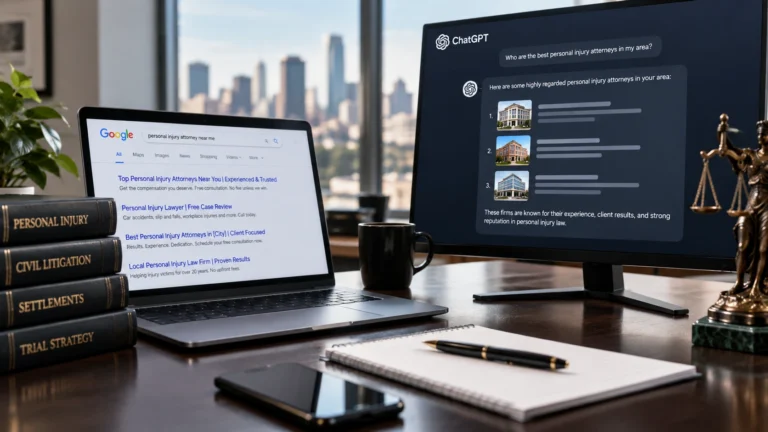
Your Google rankings look fine. Your PPC spend is holding steady. And yet a competitor keeps showing up in AI-generated answers for the exact queries your firm should own. Traditional reporting has no mechanism to surface that loss. That’s the specific gap an AI Visibility Blocker Audit is built to find and close.
Key Takeaways
- An AI Visibility Blocker Audit evaluates whether AI systems can understand, verify, and cite your firm, not whether Google can rank your pages. Those are different questions with different answers.
- Strong results follow a consistent pattern: blockers addressed across all three categories in the correct sequence, with no technical layers skipped.
- Content volume doesn’t substitute for entity clarity. Publishing more pages without structured data produces content humans can read and AI systems can’t parse.
- Partial fixes produce partial results. That’s predictable, not accidental.
- Every month a competitor builds AI recommendation authority, their position becomes structurally harder to displace.
What Exactly Is an AI Visibility Blocker Audit?
An AEO Blocker is any structural, technical, or authority-signal gap that prevents an AI system from confidently recognizing, categorizing, and citing a business as a trusted source.
The audit is the diagnostic first stage of Elite AEO Labs’ four-stage methodology. Before any remediation begins, it maps which blockers exist across a firm’s web presence and explains precisely why each one is preventing AI systems from recommending the firm in generated answers.
The audit answers a fundamentally different question than a traditional SEO audit. Not “can Google rank this page?” but “can an AI system trust this source enough to cite it?”
Most PI firms have had SEO audits covering rankings, backlinks, and page speed. Those don’t tell you whether ChatGPT, Google AI Overview, or Perplexity can parse your firm’s practice areas, geography, attorney credentials, and case types as structured, machine-readable facts.
The criteria AI systems use to evaluate sources are distinct from what Google’s ranking algorithm measures, and most traditional audits never touch them. Understanding how AI search engines choose verified answers makes the gap between SEO and AEO concrete rather than abstract.
What Does Strong AEO Audit Performance Actually Look Like?
Strong outcomes share a consistent structural pattern. The firm identified blockers across multiple categories and addressed them in sequence without skipping the technical layer.
When all three blocker categories are fully remediated, AI systems gain the structured evidence they need to treat the firm as a citable source. Citation frequency can build as authority signals accumulate. The firm may start appearing in AI-generated comparisons and recommendations for metro-specific queries. Paid acquisition costs don’t disappear, but the firm is no longer solely dependent on click-based traffic for discovery.
The mechanism behind this is worth understanding precisely. AI systems don’t rank pages the way Google does. They evaluate sources. When a firm’s entity signals are clean, its schema markup correctly identifies practice areas and attorney credentials, and its authority citations confirm geographic and topical relevance, AI models can accumulate enough structured evidence to cross a trust threshold. That threshold determines whether a firm gets cited or ignored in a generated answer.
To make that concrete: consider a situation where a PI firm’s attorney profile pages carry no schema markup, entity signals are inconsistent across directory listings, and there’s no structured content addressing the specific case types AI systems are being queried about. In that situation, each of those gaps could independently block an AI system from confidently citing the firm. Addressing them in the right sequence, technical structure before authority signals, gives machine-readable evaluation something to work with at every layer. That kind of structural change is different from publishing more content, because entity optimization for PI firms operates at a level that most content strategies never reach.
Why Do Weak Results Happen So Predictably?
Weak results aren’t random. They trace back to failure modes that appear consistently enough to anticipate.
The most common pattern: a firm completes the audit, identifies the content gaps, and addresses only those. Schema implementation gets skipped. The result is new content that reads well to humans and stays invisible to machine parsing. Citation rates don’t improve because AI systems still can’t parse the firm’s practice areas as structured data, regardless of writing quality.
A second pattern: the firm treats authority citations as a one-time task. AI models re-evaluate sources on an ongoing basis. A static citation profile doesn’t carry the same weight over time it carried when first built, because the evaluation isn’t a pass-fail gate crossed once. It’s a continuously updated signal.
A third pattern: a firm in a high-competition metro expects the same timeline as a firm in a moderate market. Competitive density affects how much evidence an AI model needs before treating a firm as a citable source. That’s not a flaw in the methodology. It reflects how AI evaluation actually works, and it’s why the work required in a major metro differs in scope from what a less-contested market needs.
The AEO optimization sequence is structured the way it is because each layer depends on the prior one being in place. Technical structure before content. Authority signals before monitoring. Skipping a step doesn’t save time. It means the layers that follow can’t do what they’re designed to do, and the whole effort produces outcomes that look like partial credit because that’s exactly what they are.
What ROI Frame Do Most Firms Get Wrong?
The audit’s return isn’t measured in traffic. It’s measured in signed cases that went to a competitor who appeared in the AI answer when your firm didn’t.
Your Google Analytics won’t surface the prospects who asked ChatGPT for PI firm recommendations in your metro, received a list that excluded your firm, and called someone else. That acquisition gap is invisible in traditional reporting. It’s also why firms keep increasing PPC spend without understanding why cost per signed case keeps climbing. The leak isn’t in the ad campaign. It’s in the discovery layer the campaign never reaches.
Zero-click search behavior means AI-generated answers are increasingly where decisions form, not on your website and not after a click. If your firm isn’t in that answer, the prospect never reaches your site regardless of how well your ads convert. Understanding how AI search engines actually recommend businesses makes clear why ad spend and AI visibility are solving different problems.
If your firm is in an expansion phase, adding attorneys and intake staff, the cost of waiting on AEO blockers compounds in a specific way. AI systems weight established, consistently-cited sources more heavily than new entrants. Every month a competitor builds citation authority is a month their position becomes structurally harder for a late mover to close.
Waiting isn’t a neutral position.
Outcome Matrix: What to Expect Based on Severity and Completeness
| Situation | Approach | Likely Pattern |
|---|---|---|
| Low severity, one blocker category, full remediation with Elite AEO Labs | Complete audit, all layers addressed in sequence | AI citation signals begin building; strong forward trajectory |
| Moderate severity, two blocker categories, full remediation with Elite AEO Labs | Authority signals and schema both addressed | Citations can build progressively as authority signals accumulate |
| High severity, three blocker categories, full remediation with Elite AEO Labs | Full sequence, national media distribution, 1,000-plus citations | Visibility may shift meaningfully as each layer reinforces the next |
| Any severity, partial fix (content only, schema skipped) | Content added without structured data or authority signals | Minimal AI citation improvement regardless of content volume |
| Any severity, partial fix (schema only, authority signals skipped) | Technical readability improves, citation history stays thin | Technical layer in place; insufficient trust evidence to generate citations |
| High severity, no action or waiting | Competitors continue building citation authority uncontested | Blockers remain; displacement becomes progressively harder |
The matrix describes patterns, not guarantees. Competitive conditions, existing domain authority, and consistency of ongoing monitoring all affect actual outcomes. What it makes clear is that partial fixes produce partial results, and waiting allows competitors to widen a structural gap that grows harder to close over time.
Who Gets the Most From This?
The audit produces its strongest results for PI firms already spending meaningfully on acquisition, with intake capacity to handle increased case volume, and a willingness to measure marketing against signed cases rather than impressions or clicks.
Firms in high-competition metros spending significant sums on PPC are the clearest fit. The Authority plan at $2,500 per month includes 1,000-plus authority citations, up to four AI-optimized content pieces monthly, and national media distribution to more than 300 trusted news and social platforms. Set against typical PI settlement values, the math on a single additional signed case isn’t complicated.
One limitation worth stating directly: the audit identifies what’s broken and explains why. It doesn’t guarantee a specific number of signed cases in a specific timeframe, because AI systems are probabilistic and competitive conditions vary. What the audit does is remove the structural reasons AI systems have to exclude your firm from generated answers. Without addressing those blockers, those structural reasons don’t resolve on their own.
Firms that aren’t ready to measure marketing against signed cases, or that treat marketing spend as a commodity line item, won’t extract the full value from this work. The audit identifies real blockers and the remediation requires real execution.
If your competitors are showing up in AI-generated answers for searches your firm should own, the audit is the right starting point.
Frequently Asked Questions
How long does it take to see results after completing the audit?
There’s no single timeline that applies across all markets and blocker categories, and stating one would be misleading. Results depend on the severity of blockers identified, how completely they’re remediated, and the competitive density of your metro market. High-competition markets with three blocker categories require substantially more authority signal than moderate markets with one, and realistic timelines reflect that difference.
Does the audit replace existing SEO or PPC strategy?
No. The audit addresses a different layer of the acquisition environment. PPC and traditional SEO still drive click-based traffic. The audit identifies why AI systems aren’t recommending your firm in generated answers, which is a separate channel that traditional audits don’t evaluate and that traditional reporting doesn’t measure.
What are the three blocker categories the audit evaluates?
The audit covers structural gaps in how AI systems parse and categorize your firm’s entity, technical gaps including schema markup and machine-readable structured data, and authority-signal gaps covering citation consistency and geographic or topical relevance signals that AI models use to verify credibility. All three categories need to be addressed, and in the right order.
Why do partial fixes consistently produce weak results?
AI systems evaluate sources holistically, not page by page. Clean schema without authority signals gives technical readability but insufficient trust evidence to warrant a citation. Well-structured content without schema isn’t machine-parseable at the entity level. Each layer depends on the others being in place first. Skipping steps doesn’t save time. It means the downstream layers can’t function as designed.
How is this different from what a traditional SEO agency does?
Traditional SEO agencies optimize for rankings, crawlability, and backlinks. Those signals matter for Google’s ranking algorithm. They don’t determine whether ChatGPT, Perplexity, or Google AI Overview cites your firm in a generated answer. AI systems use different evaluation criteria, including entity clarity, structured data, and authority signal consistency, and most traditional SEO audits don’t assess those signals at all.
What happens if we don’t address the blockers the audit finds?
The blockers don’t resolve on their own. AI systems will continue to have structural reasons not to cite your firm. Competitors who address their blockers compound their AI recommendation authority over time. The longer that gap runs, the harder it becomes to close, because established citation patterns carry more evaluative weight than new entrants attempting to catch up.
Is the audit a one-time service or part of ongoing work?
The audit is the diagnostic starting point. Remediation and ongoing monitoring are separate phases. AI search platforms update their evaluation criteria continuously, which means a one-time fix doesn’t hold its position indefinitely. Ongoing monitoring exists because AI visibility isn’t a static achievement. It’s a maintained position that requires continuous adaptation as the platforms themselves evolve.
About the Author
Brett Franks is the Co-Founder and Lead Strategist at Elite AEO Labs. He specializes in Answer Engine Optimization and Generative Engine Optimization, helping businesses transition from traditional SEO to machine-readable digital authority that gets recognized and cited by AI systems including ChatGPT, Perplexity, and Google AI Overview. Elite AEO Labs provides done-for-you AI Visibility and Authority Optimization services for growth-oriented personal injury firms across the United States.